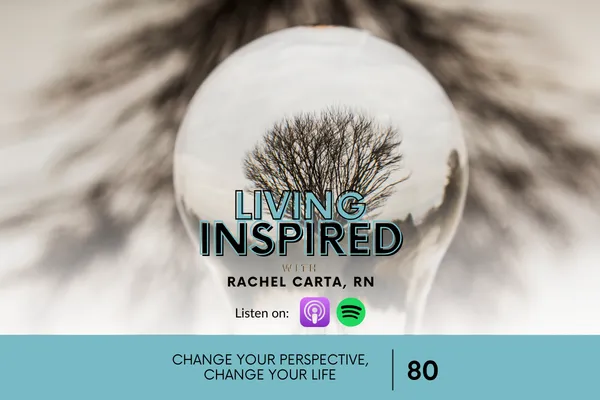
Change Your Perspective, Change Your Life
Listen to the full episode above or on Apple or Spotify.
The Power of Perspective
Have you ever noticed how easy it is to wait? To wait for things to calm down. To wait for life to feel lighter. To wait for the next milestone, the next season, the next version of yourself.
I didn’t realize how much of my life I was spending in that waiting space until a moment in nursing school changed everything for me.
I was caring for a woman who was nearing the end of her life. Because I was a student, I had the rare gift of spending an entire day with just one patient. We talked about her life. Her story. Her challenges. She had raised eight children and carried more responsibility than most people ever should.
At one point, I said to her, with as much compassion as I could muster, “That must have been incredibly hard.”
She looked at me, calm and steady, and said, “It's all hard, dear.”
She didn’t say it with bitterness. She didn’t say it with regret. There was a peaceful acceptance in her voice. And in that moment, something clicked. I realized how much of my life I had spent waiting for “hard” to end. Waiting for things to finally feel easy. Waiting for the version of life where everything lined up just right.
What she helped me see was this: Hard isn’t a season you graduate from. It’s part of being alive.
If you are breathing, if you are living on this planet, challenges will exist. Maybe not today. Maybe not tomorrow. But they will come. The question isn’t whether life will be hard. The question is how we meet it.
Finding the Sacred
Over the years, especially through my work as a nurse and hospice nurse, I’ve seen this truth over and over again. I’ve witnessed moments that were gut-wrenching and sacred at the same time. Pain and beauty sitting right next to each other.
One of the most profound moments of my career was being present for a man’s final breath. His wife climbed into bed with him. He rested his head on her chest. I held his hand. I held hers. We formed a quiet circle as he took his last breath. It was devastating. And it was holy.
Both things were true.
That experience, like so many others, reminded me that life does not separate the beautiful from the painful. They often arrive together.
And that brings me to a question that stopped me in my tracks when I first heard it years ago: What if your life is happening for you, not to you? Not as a way to explain away suffering. Not as a spiritual bypass. And certainly not as a “everything happens for a reason” slogan.
Because some things are just deeply unfair. Some losses don’t make sense. Some pain never gets neatly wrapped up. But what if, instead of asking “Why is this happening to me?” we asked, “How might this be shaping me?” What if the hard things weren’t here to break us, but to reveal us?
I’ve seen this play out in my own life. Experiences I never would have chosen ended up shaping how I show up in the world. How I care for patients. How I love my family. How I hold space for others. Even how I teach and guide now. At the same time, I know this isn’t easy to look at. It takes courage. Courage doesn’t mean you aren’t afraid. It means you feel the fear and you stay present anyway.
Finding Stillness
That’s why, about 11 minutes into this episode, I included a short guided meditation. It’s there to help you pause, breathe, and gently reflect on your own perspective. This isn’t about forcing meaning or figuring everything out. It’s about creating enough stillness to notice what’s already there.
If you’re listening and something feels tender, that meditation is an invitation to meet yourself with compassion rather than judgment.
You don’t need to rewrite your story today. You don’t need to find silver linings. You don’t need answers.
But I do invite you to notice what you’ve been through. To acknowledge your resilience. To recognize that the hard things you’ve survived may be part of what’s shaping the person you are becoming.
There is something strong and beautiful inside of you, even if you can’t see it yet. And sometimes, the shift that changes everything isn’t life getting easier, but our perspective becoming wider.
The Midlife Shift
This conversation feels especially important for women in midlife. This season often brings unexpected shifts. In our bodies, our energy, our emotions, and the roles we’ve carried for decades.
Many women come to me feeling confused, frustrated, or like something is wrong with them because what used to work no longer does. But so often, midlife isn’t a breakdown. It’s an invitation. An invitation to listen more closely, to tend to the nervous system, to honor what the body is asking for, and to relate to this season with curiosity instead of self-blame. Perspective matters here. When we stop seeing these changes as something happening to us and begin exploring how they might be guiding us toward more grounded, supported, and sustainable ways of living, everything starts to shift.
I'm so grateful for you.
Lots of love,
Rachel