
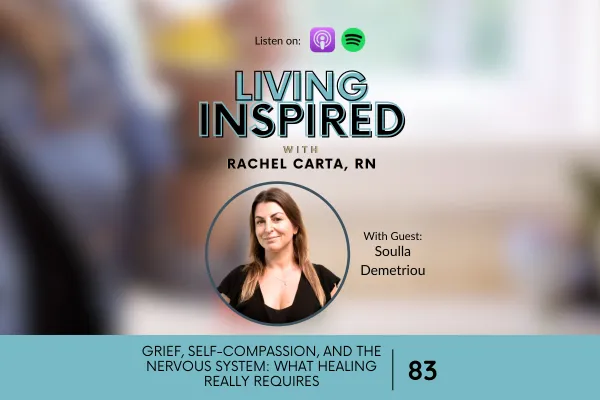
Grief, Self-Compassion, and the Nervous System: What Healing Really Requires
Listen to the full episode above or on Apple or Spotify.
This reflection grew out of a conversation with somatic and transformational coach Soulla Demetriou, whose work around nervous system healing and self-compassion deeply shaped the insights shared here.
When The Body Holds What The Mind Has Moved Past
If you have ever felt like your body is carrying something you thought you had already worked through, you are not imagining it.
So many women arrive here feeling confused by symptoms that do not seem to make sense. Fatigue that lingers. Digestion that feels unpredictable. Sleep that never quite restores. Emotions that feel bigger, sharper, or harder to regulate than they used to. Often, the story underneath those symptoms is not about willpower, discipline, or doing more. It is about a nervous system that has been holding too much for too long. Healing begins to look different when we understand that the body does not forget what the mind tries to move past quickly.
Grief Is Not Rare. Space To Feel It Is.
Grief is not an exception to life; it's part of it. Yet in many cultures, especially our own, grief is treated as something that should be contained, managed, and resolved on a schedule. There is often an unspoken pressure to be okay, to move on, to return to productivity as if loss has an expiration date. When that space to feel is missing, grief does not disappear. It simply goes underground.
What makes this even harder is that not all grief is visible. Some losses are never spoken out loud. The grief of a life that did not unfold the way you hoped. The grief of relationships, roles, or identities that changed without your consent. The grief of becoming a mother in a way you never imagined, or not becoming one at all. These experiences matter, even when they are not acknowledged by others, and the body carries them quietly.
Why Avoiding Grief Often Shows Up As Symptoms
The body needs a sense of safety to heal. That safety comes when the nervous system is allowed moments of rest, digestion, and emotional processing. When grief, loss, or disappointment are pushed aside in the name of coping, the nervous system often stays in a state of vigilance. This is where symptoms begin to make more sense.
A body that feels braced all the time may struggle with sleep. A digestive system that never fully relaxes may become reactive. Hormonal patterns can feel more volatile when the nervous system is constantly scanning for threat. These are not random failures. They are signals from a system that has not been given permission to soften.
Grief As A River, Not A Problem To Solve
One of the most grounding ways to understand grief is to stop treating it as something to fix.
Grief moves more like a river. Sometimes it rushes with force, reshaping everything in its path. Other times it slows to a quiet current. It does not move in straight lines, and it does not respond well to pressure. Healing does not come from damming the river, but from becoming a steady container that allows it to move.
This is where resilience lives. Not in pushing grief away, but in trusting that it can move through you without destroying you.
The Second Layer Of Suffering We Often Add
Pain is unavoidable. Loss happens. Bodies change. Relationships shift. What often creates deeper suffering is what we add on top of that pain. The meaning we assign. The stories we tell ourselves about what it says about us or our lives. This is where so many women get stuck, not because the experience itself was too much, but because the interpretation became heavier than the moment required.
Learning to notice this layer gently, without judgment, can create space. Pain does not have to become a verdict. It can simply be pain.
Why Self-Compassion Is The Foundation Of Healing
Self-compassion is often misunderstood as something soft or optional. In reality, it is one of the most stabilizing forces we have access to.
Without self-compassion, even supportive habits can feel like pressure. Rest feels earned. Nutrition feels corrective. Nervous system practices feel like another task to complete correctly. With self-compassion, those same practices begin to feel like care.
Self-compassion asks a simple but powerful question: can you be with yourself the way you would be with someone you love, especially when things are hard?
Not only on the good days, but on the tired days. The grieving days. The days when you feel reactive, discouraged, or unsure.
Small Moments That Change The Nervous System
Self-compassion does not require long routines or perfect conditions. It is built in small moments that add up over time.
A hand on your heart. A pause before reacting. A quiet check-in that asks, what do I need right now? These moments create space between life happening and how you respond to it. Over time, that space becomes the place where healing begins.
From a nervous system perspective, this space often opens when the body feels safer. That might come through breath, gentle movement, music, time in nature, or simply stepping outside and letting your system register something steady and familiar. What matters is not the method, but the exhale.
When We Numb Grief, We Also Numb Joy
There is a cost to avoiding grief that is rarely discussed. When we shut down our capacity to feel pain, we also limit our capacity to feel joy, connection, and aliveness. We do not get to selectively choose which emotions are allowed.
Healing does not mean drowning in feeling. It means allowing the full range of experience to move through with enough kindness and support that it does not overwhelm the system.
Healing Begins With Allowing, Not Pushing
This perspective changed how I think about healing because it shifts the focus away from fixing and toward relating. Healing is not about forcing the body to comply or pushing yourself through another plan. It is about learning how to be with yourself honestly, gently, and consistently, especially in the places that feel tender.
Grief does not need to be rushed. Self-compassion does not need to be earned. And healing often begins the moment you stop turning away from what has been asking to be felt.
Lots of love,
Rachel
About Our Guest:
Soulla Demetriou is a Transformational and Somatic Therapeutic Coach, Internal Family Systems practitioner, and creator of The Soulshine Way, a transformative approach to self-compassion, nervous system healing, and inner liberation. Her work helps people build a loving and trusting relationship with themselves, so they can finally stop living through the wounds of the past and step into the freedom of their true Self. Drawing from Internal Family Systems, somatic psychology, spiritual connection, and over a decade of coaching and retreat leadership, Soulla supports clients and communities worldwide through her Soulshine Retreats, programmes, 1:1 mentorship, and her forthcoming book You Have Always Been Enough - A Healing Guide to Self-Love and Inner Freedom.
Website: https://www.withsoulla.com
Book: https://www.withsoulla.com/always-enough
Instagram: https://www.instagram.com/withsoulla
Free Self-Compassion Course: https://www.withsoulla.com/courses/7-steps-course-sign-up