
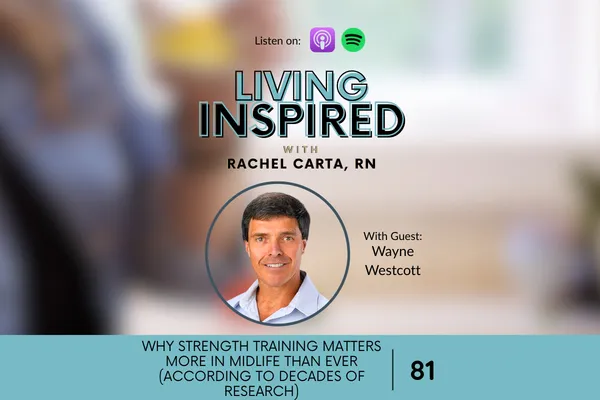
Why Strength Training Matters More in Midlife Than Ever (According to Decades of Research)
Listen to the full episode above or on Apple or Spotify.
The Power of Strength
For a long time, strength training was something I thought about mostly in terms of fitness. How I looked. How strong I felt. What my body could do in the gym. But as I’ve gotten older, and as I’ve spent more time working as a nurse and walking into nursing homes, my perspective has shifted. Now when I think about strength, I think about much simpler things.
Can you walk up the stairs without holding the railing?
Can you carry your groceries?
Can you get yourself up off the floor if you need to?
These are the kinds of questions that start to matter in midlife. And they’re the questions I hear behind so many of the symptoms women bring into my work. Fatigue. Weight gain. Low mood. Feeling less steady in their bodies than they used to.
That’s why my recent conversation with Dr. Wayne Westcott felt so important. Dr. Westcott is one of the most respected researchers in the field of strength training. He’s published hundreds of studies, written dozens of books, and taught at institutions like Harvard and Yale. But what struck me most, both years ago when I was his student and again in this conversation, is how grounded he is.
He has a way of talking about strength that removes the fear and the pressure. He doesn’t make it about pushing harder or doing more. He makes it about supporting the body in a way that’s practical, safe, and realistic for real life.
And what the research shows, when it’s explained that way, is actually incredibly hopeful. Muscle is not just about strength. It’s about function. One of the things he explained early in our conversation is that muscle plays a much bigger role in the body than most people realize. Muscles are where movement begins. They’re where power is produced. They’re part of what allows us to stay independent as we age.
As we get older, we naturally lose fast-twitch muscle fibers. These are the fibers that help us move quickly, catch ourselves if we trip, and respond when something unexpected happens. Losing them doesn’t just affect athletic performance. It affects everyday life. Your balance, your walking speed, and your ability to recover from a stumble instead of falling. And when muscle declines, it often brings other changes with it. Metabolism slows. Bone density declines. Confidence drops and the body starts to feel less predictable.
What stood out to me is how long strength can actually be maintained compared to other physical abilities. Speed and endurance tend to decline earlier, but strength can be preserved well into later decades with the right kind of training. That matters more than most of us have been told.
The Nursing Home Study That Changes The Conversation
Dr. Westcott described a study done in a nursing home setting in which the average age of the participants was around 90. Many needed assistance walking. Some used canes, walkers, or wheelchairs. These were not people who had been active or exercising regularly. They followed a very simple strength training program. Five exercises, twice a week. The entire workout took about 10 minutes. After roughly 12 to 14 weeks, the changes were significant.
Participants increased their strength dramatically, especially in the lower body. Many were able to walk more independently. Falls decreased. Several people no longer needed their canes or walkers. On average, they gained about four pounds of muscle and lost about three pounds of fat, without changing their diet.That is a seven-pound improvement in body composition in people around the age of 90.
What struck me most was not just the numbers, but what those changes meant. Increased independence. Better mobility. More confidence in daily life. That's everything. If that kind of change is possible at 90, it raises an important question for women in their 40s, 50s, and 60s.
What might be possible now?
What “Strength Training” Actually Means
For some women, the phrase strength training alone can feel intimidating. It brings up images of heavy weights, crowded gyms, or programs that feel overwhelming.
Dr. Westcott described it very simply.
Strength training means asking your muscles to work against resistance that’s greater than what you encounter in daily life.
That resistance might come from dumbbells, machines, resistance bands, or even your own body weight. The goal is not complexity. It’s stimulus.
Muscle responds when it’s challenged in a safe, controlled way. And it doesn’t take hours. In many of Dr. Westcott’s studies, participants did one set of basic exercises targeting the major muscle groups. Sessions were short, focused, and consistent. This kind of training supports muscle, bone, balance, and metabolism without taking over your life.
Strength, Metabolism, and the Midlife Weight Conversation
Midlife weight gain is often blamed entirely on hormones. While hormonal changes do play a role, Dr. Westcott explained that muscle loss is a major part of the picture that often gets overlooked.
As muscle declines, resting metabolic rate declines with it. That means the body burns fewer calories at rest. Many women respond by eating less or dieting. The problem is that calorie restriction alone often leads to further muscle loss. When muscle decreases, metabolism slows even more, making it harder to maintain weight over time. This is one reason so many diets fail long-term.
Dr. Westcott shared research showing that when strength training is combined with a sensible diet, some endurance movement like walking, and adequate protein, the body responds very differently. Instead of just losing weight, people lose fat while maintaining or even rebuilding muscle. Body composition improves. Strength improves. And importantly, those changes are more likely to last.
In follow-up studies, participants who continued a simple strength and movement routine were able to maintain their weight and continue improving muscle mass even after returning to normal eating. That kind of sustainability matters.
The Mental and Emotional Impact of Strength
Dr. Westcott has been involved in research showing that strength training improves mood, confidence, and self-efficacy, particularly in older women. Depression scores improved. Confidence increased. People felt more capable in their bodies.
I’ve felt this myself. When I wasn’t able to strength train for a period of time due to chronic migraines, I noticed the mental toll almost immediately. My mood shifted. My resilience dropped. Everything felt harder. Returning to strength training wasn’t just about rebuilding muscle; it was about rebuilding steadiness.
For many women in midlife, that steadiness is exactly what feels lost. You don’t need to do everything. One of the biggest mistakes is not starting at all. The second biggest mistake is trying to do too much too soon. You don’t need a perfect program or every exercise imaginable. A small number of well-chosen movements that target the major muscle groups can go a long way. Consistency matters more than complexity.
And strength training is adjustable. If you reach a point where you like how you feel, you can maintain. You’re not locked into constantly doing more. This is not an all-or-nothing practice.
Why This Matters Now
As we age, the question isn’t whether our bodies will change. They will. The real question is how supported we want to feel inside those changes. Strength training is not about chasing youth or aesthetics. It’s about preserving function, confidence, and quality of life. It’s about staying capable in your body for as long as possible. And the research is clear. The body responds at any age.
Lots of love,
Rachel
About today’s guest:
Dr. Wayne Westcott is a retired professor of exercise science and a leading researcher in strength training. He has authored over 100 peer-reviewed research studies, written 30 books, and contributed to national certification textbooks. His work has influenced how strength training is taught and practiced around the world, with a focus on safety, simplicity, and effectiveness across all ages.