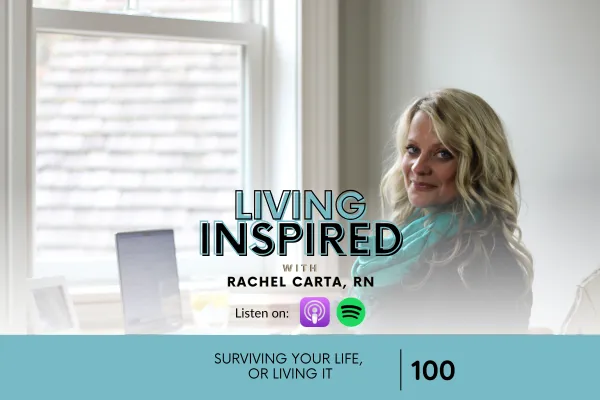
Surviving Your Life, or Living It
You can listen to the full podcast episode using the embedded player above.
"The way we live and the way our bodies respond to that living are not separate things."- Rachel Carta, RN, CFNC
The Bill Comes Due: What 100 Episodes Taught Me About Slowing Down
When was the last time you actually slowed down? Not to scroll your phone. Not to half-rest while a list runs in the back of your mind. I mean really slowed down, with no agenda, just to be. If you had to think about that for more than a few seconds, stay with me. This one is for you.
This is episode 100 of the Living Inspired Podcast, and I'll be honest, I've struggled with what to say. My mind has been going in every direction, because I'm sitting here reflecting on who I was at the beginning, who I am now, and what I've learned along the way. Right before I pressed record, I sat in a staff bereavement meeting through the hospice work I still do, and the social worker asked a question that wouldn't leave me. How has this changed you? In what way have you been changed? So I want to reflect on that out loud. And I want you to reflect too. What in your life has shifted over the years without you ever naming it?
The Seed Was Planted at Ten
I didn't arrive at what I believe today overnight. The first seed went into my body when I was ten years old, the year my father, who was my absolute hero, had his first heart attack. After it, I went with him to cardiac rehab. I can still remember sitting in that room as a ten-year-old, surrounded by adults working to rebuild their hearts. I didn't have language for it then, but something in me started forming an idea I've never let go of. The way we live and the way our bodies respond to that living are not separate things.
My father was a salesman, though not the kind that word usually brings to mind. He sold life insurance, and what he really did was know people. He asked questions. He listened. He had eleven kids, and every single one of us felt like the most important person in the room. Back before bills came out of your account automatically, he drove a debit route, collecting small premiums by hand, checks of ten or twenty dollars, often from elderly clients who lived alone.
He never rushed them. He'd sit, take the coffee they offered, and stay a while, because he understood he might be the only person some of them spoke to all week. I'd ride along in the summer and crochet or read in the houses that were safe for me to enter, and I absorbed something in those rooms about caring, listening, and seeing a whole person instead of a transaction.
Here's what took me far too long to notice. I am so much like him in that exact way. When a woman comes to me, it's never only about the symptom she leads with. I see the person, the story, the whole life that brought her to my door. Every hard thing you've lived through, every stressful season, is connected to how you feel in your body today.
A Medication Delivery Service
Years after that rehab room, I became a nurse, and I entered the field during COVID. I thought nursing was the work of bringing health back to people. What I found was that I rarely had time to listen, to sit in someone's story, to ask the question that mattered most to me. Why is this body manifesting this symptom? I felt like a medication delivery service. We were managing diseases with pills and interventions, often keeping people stable, but inside a system that was never built to ask why. I'm not saying conventional medicine has no place. It absolutely does, and it saves lives. I am saying it tends to miss the mark on anything chronic.
Picture a pot of water boiling on the stove with a lid on it, and you walk away and forget it. The water boils off, the pan scorches, the stove gets damaged. Treating a chronic symptom with only a pill is putting the lid back on. Everything underneath keeps heating up. What we do as functional nutrition counselors is walk over and turn off the stove, so the symptom doesn't have to keep showing up in the first place. The more I worked, the more certain I became that the real healing had to happen somewhere the conventional model wasn't looking.
The Last Three Nights
My father's health kept declining over the years. He'd had good years after that first heart attack, years of treadmills and cutting out white bread and ice cream, but slowly his lifestyle drifted and his health followed. I watched his life narrow as disease took things from him one at a time. His energy. His freedom. A man who lived to be around people, losing the very thing that made him himself. Then dementia came. The full life he should have had to the very end was cut short, and the last ten years were harder than they may have needed to be, had any of us understood then what I understand now about lifestyle and choices and how to talk about them.
For the last three nights of his life, I slept in a chair beside his bed. I kept reminding myself to stop being a nurse. Be the daughter. It is so much easier said than done. On his last morning, even though he'd been unresponsive for over a day, I told him what a wonderful father he'd been and named the lessons he gave me, and the words felt like they were moving through me from somewhere beyond myself. His final moments were hard. One of my hands was on his face, the other on his pulse, because the nurse brain never fully turns off. There was a red blanket around him, and it felt as though God was in the room with us.
When his heart stopped and his last breath ceased, something happened in me that has not changed back since. It felt like a clear message. It was time to stop dabbling and go all in on serving the women I was meant to serve, whether I felt ready or not. Before their bodies start screaming. Before too many years get stolen. Before a woman looks up and realizes she's been surviving her life instead of living it.
What I Got Wrong, and What the Body Was Doing All Along
When I started this business in 2021, I was teaching women inner peace, and that felt true. It turns out it was a real piece of the puzzle, just an incomplete one. If you go back to my early episodes, you'll hear me talking mostly about the mind. What I didn't yet grasp was how profoundly dysregulated most women are, and how little they realize it.
Unprocessed stress, unexpressed grief, and years of running on cortisol don't politely confine themselves to anxiety and exhaustion. When the nervous system lives in a chronic low-grade threat state, the body adapts in ways you can feel. Digestion can slow or churn. The immune system can lose its footing. Hormones can swing in ways no one seems able to explain. Your body has been trying to get your attention for a long time.
Then midlife arrives and the margin changes. The things your body used to absorb, the skipped meals, the single rough night of sleep, the chronic overgiving, the relentless internal urgency, they stop being free. There's no more buffer. So women come to me genuinely bewildered. I'm doing all the things I've always done, so why is my body suddenly pushing back? Here's the truth as I see it. Your body was always paying the price. Perimenopause just stopped letting you defer the bill. The wall between how you've been living and how your body feels has come down.
This is the reframe I most want you to take with you. The symptoms are rarely the problem. They're the body's response to a problem that's been building for years. The women I work with aren't screwing up their health. They're living at a speed that has a body consequence. That distinction changes everything about how you treat yourself from here.
Living at a Pace You Can Sustain
So here is what living inspired actually means to me now, after a hundred episodes. Inspired means to be breathed into. Living inspired means living at a pace your body and soul can actually sustain. It means building your days with enough intention that you know what truly matters to you, not what the world insists should matter. It means closing the laptop and walking into the kitchen and actually being in the room with your family, not arriving in body while your mind is still tangled in everything you did or didn't finish. It means asking honestly whether the way you spend your time and attention points toward what you actually care about.
I read a book recently called The Ruthless Elimination of Hurry, and the title alone says so much. The urgency we live in has become the water we swim in, the constant sense that everything is important and immediate and cannot wait. We've been in that state so long that many of us have forgotten what came before it. But your body remembers. You don't have to overhaul your life or add another protocol to begin answering it differently. You can start with something almost embarrassingly small. The tiny bites are what expand your body's capacity to heal.
One Understanding, One Step, One Shift
The understanding: Your symptoms are a record, not a verdict. They're the body keeping score of everything you've carried, which means they can be read and responded to rather than simply silenced.
The step: Today, if you can, go outside. Stand in the sun for a few minutes. Look at the trees. Feel the ground under your feet, and let your nervous system remember what stillness feels like. Not to fix everything, but because you're a human being and not a machine.
The shift to experiment with: Find one moment in your day, just one, where you arrive fully in your body and let your mind catch up to where your feet already are.
You've carried a lot to get here, even if I don't know your specific story. It cost you something to keep going through the seasons when going was all you could do. That's not a reason for shame. It's a reason to get honest.
Your life is sacred. Not someday when things calm down. Not when everyone else is finally taken care of. Right now. This moment, exactly as it is. Breathe in. Breathe out. Honor yourself. Honor everything it took to get you here. This is why I'll keep showing up for you.
Lots of love,
Rachel
Rachel's Free Resources:
Mood Swings? Get the 5 minute audio to calm them now. https://rachelcartarn.com/sos
Do you want to understand more of what's changing in your body in midlife and get a few simple tools to feel better now? Get the free guide: The Real Reason You Still Feel Off.
Ready to Talk: Book a Clarity & Relief Session here.