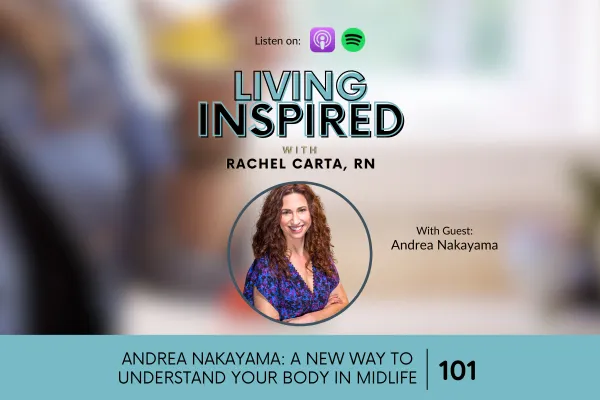
ANDREA NAKAYAMA: A New Way to Understand Your Body in Midlife
You can listen to the full podcast episode using the embedded player above.
"The name of the disease doesn't matter. It's the human in front of us that matters." — Andrea Nakayama
The Tree, the Terrain, and Why You Were Never the Problem
When I was in nursing school, I made note cards for everything. I was a good student, the kind who studied hard and double-checked her own work, and my cards were a system I trusted completely. On one side I wrote the symptoms. On the other side I wrote the disease those symptoms added up to, and somewhere on that same card, the medication we used to treat it. Symptom, disease, drug. That was the equation. Those cards are probably still in a box in my house somewhere, and for a long stretch of my life I believed they held the whole truth about how a body works.
They didn't. Not even close.
I sat down recently for an episode of Living Inspired with Andrea Nakayama, and I have to tell you, she is one of a small handful of people who have changed the way I think in nearly every part of my life. She is a pioneer in functional nutrition and the founder of the Functional Nutrition Alliance, which is where I went to nutrition school. It is, in a very real way, why I think the way I think and do what I do. What pulled me toward her work wasn't only the nutrition science, though there is plenty of that. It was that she sees the person. Not the diagnosis. Not the symptom list. The person sitting across from her. This is a conversation about what happens when you start to see your own body that way too.
A Different Way of Seeing
Andrea's way of looking at the body didn't come from a textbook. It came from the hardest season of her life. In April of 2000, when she was seven weeks pregnant, her late husband, Isamu, was diagnosed with an aggressive grade four brain tumor. He was given six months and was not expected to see their son born. He lived two and a half years. Their son was nineteen months old when Isamu died, and that boy is now twenty-five and living in Tokyo.
What she noticed in those early days, as an outsider to the medical system, shook her. People, she realized, were being treated like their diagnosis. They were not Andrea and Isamu and the whole of who they were. They were what they had. And the second thing she saw was just as unsettling: people with the same diagnosis were treated the same way, as though two human beings carrying the same label arrived with the same body, the same history, the same life.
I want to be clear about something Andrea is careful about, and so am I. This is not about vilifying medicine. Medicine does something, and it does it well. If I break my leg, I know exactly where to go. If I need stitches, thank goodness for the emergency room. But here is what I see in my own practice, over and over, that confirms what she learned in that hospital. When a new client sits with me and I ask what else was happening in her life when her first autoimmune symptoms appeared, or what was going on the year she got that diagnosis, something shifts in her face. She starts connecting threads she had never thought to connect. Most of us were never taught that the weight of a life leaves a mark on the body. That the story and the symptom are not separate things.
"The name of the disease doesn't matter. It's the human in front of us that matters." — Andrea Nakayama
Build Your Own Ecosystem
We have asked one kind of provider to be our everything, and the medical system was never built for that. Somewhere along the way, medicine became "healthcare" in our minds, and so we walk into a doctor's office expecting answers about our nutrition, our stress, our environment, our mental health, our relationships. But your doctor was trained in disease. That is their scope, and it is a good and necessary one. It was never their job to know your nervous system or what you eat or what you are carrying.
She traces a lot of this back to 1910, when a man named Flexner created a model of medicine that was strictly biomedical. The herbalists, the midwives, all the people who used to do the work in the long stretches between acute emergencies, were suddenly on the wrong side of a line. What we lost was a kind of pluralism, a whole spectrum of support, and we have been paying for that loss ever since.
Picture this: you have an electrician, a plumber, an HVAC person, and a painter. Each is genuinely skilled at their own work, and we don't hand the plumber a ladder and ask him to rewire the lights. So why do we expect one human in a white coat to hold all of it for us? When you let your doctor do what your doctor does, and then build out your own ecosystem of support, you can feel the pressure come off. You are allowed to hire someone for your nutrition. You are allowed to have someone for your mental health. (And add on any support that you find.)
Story, Soup, and Skill
The framework that reorganized my entire brain is something Andrea calls the matrix, and it has three parts: the story, the soup, and the skill.
The skill is the what-do-I-do layer. How do I eat, how do I sleep, what kind of water do I drink, how do I move. This is where most of the noise lives.
The soup is the body itself, the systems biology, the way the gut talks to the brain and the brain talks to the liver and the liver talks to your hormones. Everything is connected in there, which is true and beautiful and also where a different kind of noise has crept in, according to Andrea. We have gotten convinced that the fix will come from naming the mechanism. It's the mitochondria. It's the microbiome. It's the methylation. It's the hormones. If those words mean nothing to you, please don't worry. They are simply what gets sold to us, and your hormones in particular do not exist in isolation. They are one ingredient in the soup.
And then there is the story, which is the part that kept getting lost. Joy, grief, belonging, the year everything fell apart, the season you felt most like yourself. Not just the enormous events but the small ones too. All of it shapes your internal terrain. Narrative medicine, the practice Andrea eventually trained in, is really deep listening, and I believe we can turn that same listening inward.
The Tree and the Terrain
Imagine a tree. Every sign, every symptom, every diagnosis you are living with is a branch. It's what is expressing itself, what you can see. But you don't help a struggling tree by cutting off its branches. You go down. Beneath the branches are the roots of any chronic issue: your genes, your digestion, and your inflammation. And those roots live in soil, the terrain around them, made of your food, your movement, your environment, and your mindset.
This is the part I love, because it takes us out of the frantic search for the one root we're being told we have to find. Digestion isn't only the microbiome you keep getting sold a protocol for. It's mechanical and chemical and structural too. You can begin by chewing your food. That's it. Just chewing does a tremendous amount for your digestive function, and when you support digestion, you support everything hanging on those branches. Inflammation works the same way. Sometimes we are clearing a food or an environmental toxin. Sometimes we are clearing a relationship that frightens us, or a career, or an environment that has stopped being safe for us. And underneath all of it is calm, because the body simply cannot heal in a constant state of fight or flight.
Here is how I want you to hold your own healing. You can ask others to help you with the roots and the branches. That's what people like me are trained for. But the soil is yours. Your job, the most human job there is, is to nourish your own soil. And not all at once. That's a lifetime, not a weekend.
Midlife and the Story We're Being Sold
Let's talk about perimenopause, because this is where the noise gets loudest. When I write or speak about midlife, I refuse to lead with hormones, and Andrea put beautiful language to why. Perimenopause and menopause are not one thing that broke and now needs fixing. They are the accumulation of the life you have been living, surfacing all at once. Yes, the hormones are shifting. But that shift tends to reveal everything you've been carrying rather than create it out of nowhere. What changes most, in my experience with client after client, is resilience. As hormones fluctuate, the nervous system loses some of its cushion, and fight or flight starts to feel like the baseline instead of the exception.
I think of the hormone hierarchy as a triangle. At the very top sit the sex hormones, the ones everyone is talking about. But at the base, holding the whole structure up, is blood sugar regulation. So consider the woman who wakes up, drinks her coffee on an empty stomach, grabs a quick bagel a few hours later, and then blames her irritability, her mood swings, and her broken sleep on perimenopause. Her blood sugar has been on a roller coaster all day. Before we reach for the top of the triangle, we have to ask whether the base is stable. Are you eating in a way that supports your blood sugar? Are you sleeping, and eliminating, and hydrating in a way that lets your body actually clear hormones rather than recirculate them?
This matters enormously, and it's where I have watched women get hurt. Hormone therapy is a genuine gift for some women. Andrea said she is glad we're finally talking about it, and so am I. She'll also tell you, honestly, that it didn't work for her own body. She measured her hormones, brought her results to four different providers, and got four different opinions, because the truth is we are not as far along in our understanding as the marketing suggests. Hormone therapy is being sold as the fix, the be-all and end-all, and it isn't bio-individualized enough to be that for everyone. Some women are helped dramatically. Some are not. And if you bring hormones into a body that isn't sleeping or eliminating or detoxifying well, the symptoms can get worse, not better. The foundation has to be there first for the hormones to even have a chance to work.
"Not everybody does well on them. And the truth is not everybody needs them." — Andrea Nakayama, on hormone therapy
When the Nervous System Is Stuck On
So much of this comes back to the nervous system, which is why nearly every coaching call I run begins with grounding and centering. There is no point handing a diet plan to a body that is bracing for a threat.
Here is what dysregulation actually feels like. You're exhausted, you finally lie down, and instead of rest, a full symphony starts up in your head of everything you didn't do and everything you have to do tomorrow. That is a sign you are stuck in the sympathetic state, in fight or flight. We are designed to move back and forth between sympathetic and parasympathetic, the rest-and-digest mode, like a tide.
The problem is getting stuck. Picture being chased by something dangerous. Every resource in your body floods toward one job: get to safety. Once you're safe, you exhale, and your body returns to the other work it needs to do, the digesting, the repairing, the calming of inflammation. But we now flip into that threat response many times a day over things that are not life-threatening at all, a packed calendar, a buzzing phone, a hard email, and we have a much harder time climbing back out. While you're stuck there, your resources are spent on reacting, not healing.
I had a client years ago with severe IBS who had done all the things. She had seen the specialists and the functional practitioners. She was on something like fifteen supplements. Nothing moved. What finally changed her symptoms wasn't another pill. We actually took some of the supplements away. We built a genuinely calming nervous system routine at the end of her day, and part of it was Abhyanga, a simple self-massage, even just two minutes of it, lying on a towel in the bathroom to let the oil sink in. It might sound too small to matter. It moved the needle when nothing else had.
Andrea explained that the first muscle to build is awareness, and not so you can fix yourself in the moment, just so you can notice. She said, "I can feel when I get ramped up. I know coffee revs me higher than matcha does, even though I love them both." For myself, I know that when I open my calendar and see no white space at all, something in me goes rigid. That noticing is the whole practice. When you create even a sliver of space between the thing that happens and your reaction to it, that space starts to grow. You go from one-click impulse to something closer to choice.
What You Can Carry With You
One new understanding. Your symptoms are branches, not the root. The frantic, exhausting search for the one thing wrong with you is the wrong search. The body heals in calm, from the soil up, and you were never the problem to be solved.
One Next Step
Pick a single foundation and get curious about it, not strict with it. Three non-negotiables are sleep, poop, and blood sugar. Choose one. Don't command yourself to "sleep better." Ask, honestly, how is my sleep, how do I feel about it, what is one small thing I could tend to here. Small hinges swing big doors.
You can listen to the full conversation with Andrea Nakayama on Apple or Spotify or on the player at the top of this article.
There will be loud days. There will be tender, quiet ones. You don't have to find every root today; you only have to nourish the soil that is yours. Put your hand on your heart. You're not behind. You're not the problem. You're a whole person, living a whole life. Breathe in. Breathe out.
Lots of love,
Rachel (and Andrea)
About Andrea Nakayama
Andrea Nakayama became a Functional Medicine Nutritionist after losing her husband to a terminal brain illness in her thirties — an experience that exposed the profound gaps between medical expertise and the lived reality of disease. Navigating grief, solo parenting, and her own autoimmune diagnosis, she turned to systems biology to understand the body and narrative medicine to hold the rest. That personal search grew into the Functional Nutrition Alliance, an acquired multi-million-dollar health ed-tech company training thousands of practitioners worldwide. Today she advises at the intersection of functional nutrition, lifestyle medicine, and narrative medicine — with a focus on women in midlife and beyond.
Rachel's Free Resources:
Mood Swings? Get the 5 minute audio to calm them now. https://rachelcartarn.com/sos
Do you want to understand more of what's changing in your body in midlife and get a few simple tools to feel better now? Get the free guide: The Real Reason You Still Feel Off.
Ready to Talk: Book a Clarity & Relief Session here.