What a Gas Line Trench Taught Me About Gratitude and the Nervous System
You can listen to the full podcast episode using the embedded player above.
"Your body does not file physical stress in a different drawer than emotional stress. It registers all of it through the same threat system, and it adds it up." - Rachel Carta
It was around nine in the morning and the air was already thick. The kind of humid where your glasses fog the second you step out of the air conditioning, where you can feel the heaviness settle on your skin before you've made it across the driveway. I'll be honest about what I was thinking that morning, because it's a little embarrassing. I was thinking about my hair. Whether the humidity was going to turn it frizzy by the time I got where I was going.
My husband had asked me to stop by his job site. He's asked me plenty of times over the years, but this was the week it worked. He works in gas line construction. He digs gas lines. I know how simple that sounds when you say it out loud, and I also know I had no real understanding of what it meant until I was standing at the edge of one of those holes, watching two men do the work.
I usually keep these blogs focused on the body. Hormones, sleep, blood sugar, the nervous system, all the things that are shifting in midlife. But every so often something happens in an ordinary day that asks me to stop and pay attention, and this was one of those mornings. Living inspired has never been only about building a better body. It's about being awake to the life you're living inside of that body. So I want to take you to the edge of that hole with me.
What I Saw at the Edge of the Hole
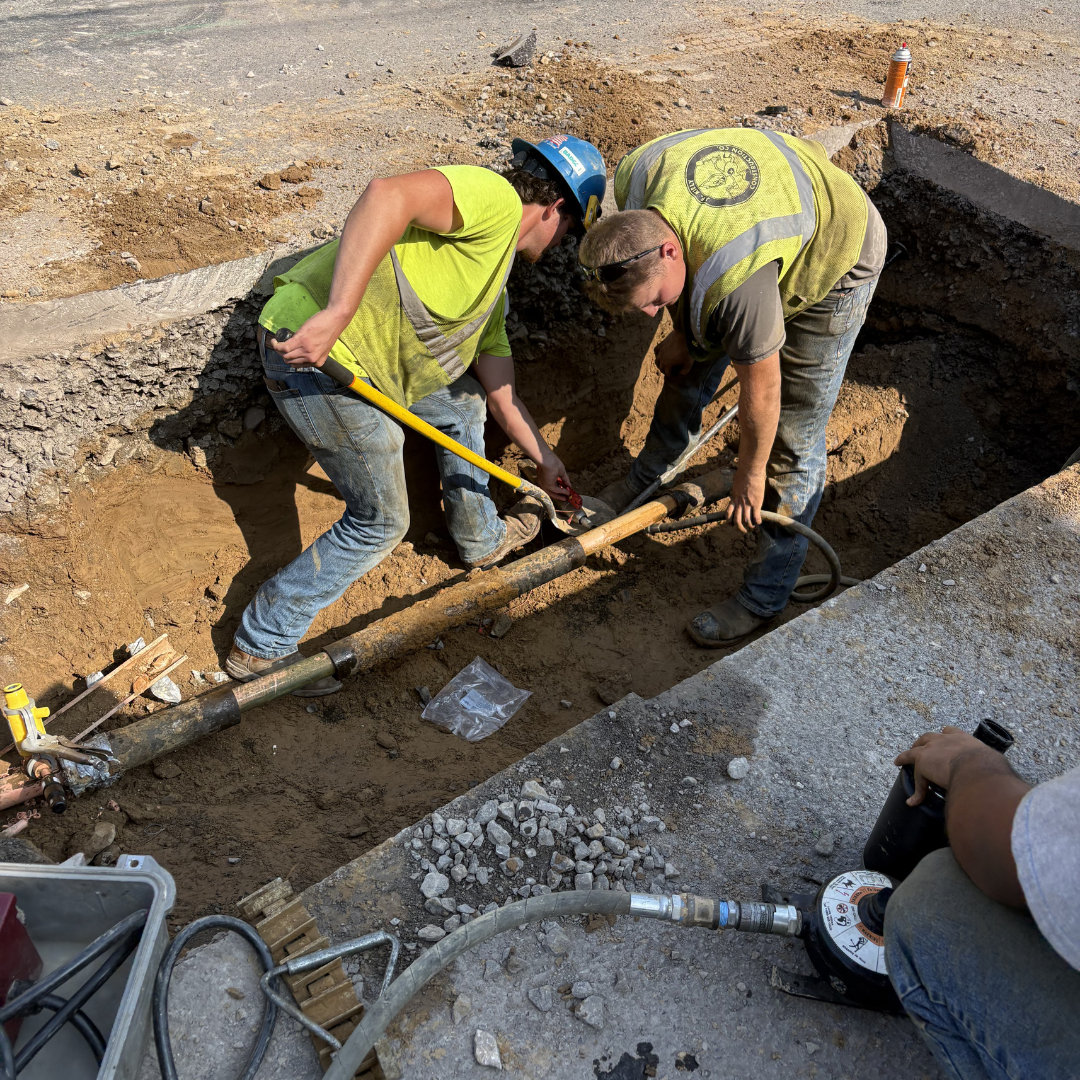
The hole was maybe five feet deep, dug right into the road. Not a soft patch of garden dirt. Concrete, fumes, the smell of the trucks, dirt everywhere. The two men were in hard hats and long sleeves and long pants in that heat, covered head to toe in dirt, using their entire bodies. The sun happened to be tucked behind clouds that morning, which barely took the edge off. Most days it's beating straight down on them.
I stood there and I went still. I've driven past men like this on the side of the road my whole life. So have you. My husband comes home covered in it, exhausted, and I've watched that for years. I knew he worked hard. But standing there, smelling the fumes, feeling the heat come up off the road, watching them lift and dig and breathe it all in, I understood maybe a fraction of it for the first time. And the honest thing is, a fraction is all I got.
This is not the kind of work someone does because it's glamorous or because a room full of people is clapping for them. Nobody is posting about it. They do it because there's food to put on the table and responsibility to carry, and the work has to be done. There is so much dignity in that. There's dignity in showing up in the heat and the sweat and doing what needs to be done for your family, with no audience at all.
If I can live with someone who does this work and still not understand the physical reality of his day, how much of the rest of the world am I moving through without really seeing it?
The Air-Conditioned Car
I got back into my car. Clean, cool, comfortable. I shut the door and the air conditioning came on and I could feel the humidity lifting off my skin. I could play music if I wanted. I could drive home to my air-conditioned house and do work that I love, work that uses my mind and my heart. And less than ten feet away, two men were standing in a hole in the heat so that the rest of us can turn on a stove and have heat in the winter.
I sat there for a minute before I pulled away, and the privilege of it hit me. Not in a guilty way. I'm grateful for the comfort I have and the work I get to do. But gratitude for comfort should make us awake to the labor that makes comfort possible. Those two things belong together.
Think about how many times we get annoyed by exactly this. The brake lights, the cones, the flag man, the lane closed ahead. We sit there irritated, asking why there's always construction, why it always takes so long. And we're saying it from inside an air-conditioned car while someone else stands in the heat doing the actual work that keeps the world running. We've made comfort the baseline. Anything that interrupts it feels like a problem. But what if the interruption is an invitation?
When I was fifteen I went on a missions trip, and one thing I have never forgotten is the smell of the streets. They were full of trash. We didn't even call them sidewalks, we called them trash trenches, because that's what they looked like. I asked one of my instructors why, and they explained that there was no regular trash pickup, no infrastructure like the kind I'd grown up assuming was just there. I bring that up because most of us expect the roads to be passable, the lights to turn on, the gas to flow, someone to show up when something breaks. None of that appears out of nowhere. Someone builds it and maintains it and repairs it, and most of the time it's somebody's physical body doing the work.
The Stress You're Already Carrying
There's a layer to this that lands right in the middle of what I teach, and I don't want to skip it. We've been taught to think of stress as a feeling. The overwhelm, the racing thoughts, the mental load so many women are carrying. All of that is real, and all of it adds to the load your body is holding. But stress is not only a feeling. It's also physical.
The heat is stress. Labor is stress. Being on your feet all day, sweating through your clothes, breathing fumes, the noise of the machinery, the danger, the sheer physical exertion. Your body does not file physical stress in a different drawer than emotional stress. It registers all of it through the same threat system, and it adds it up. Then that same body comes home and still has to be a spouse, a parent, a functioning adult. And for a lot of the women I work with, you can stack their own symptoms on top of all of it, because being unwell is its own kind of stress on the body too.
Here's why this matters for healing. When that threat system stays switched on, the part of your nervous system responsible for rest and repair doesn't get its turn. And repair is where healing actually happens. This is the state I see so many high-achieving women living in, and it's why I say it the way I do.
Healing cannot happen in a nervous system that is living at its limit.
So when I talk about pausing, about gratitude, about taking one real breath, I'm not handing you a nice idea. A genuine moment of gratitude nudges your body off the threat side and toward the side that calms and restores. That's not Pollyanna positivity. You might be in something genuinely hard right now, and I honor that. I've been there. I'm telling you that it's possible to shift your state in a moment, and that shift is doing something physiological for you, not just emotional. Standing next to that hole did exactly that for me.
Reading the Name Tag
See people. The man holding the flag. The crew digging the trench. And then everyone else too. The person who hands you your bags at the grocery store. The teller at the bank. The driver who left the package on your porch.
I've been noticing ordinary moments like this for a long time, probably since my newspaper days in the early 2000s. I once knocked on the door of an odd little A-frame house in Mount Carmel because it didn't match the row, and the owner told me it was one of the first homes Thomas Edison wired for electricity. Another morning I stopped to talk to a man standing by a Vietnam memorial, and he was amazed that anyone cared to ask about what he'd carried. That's the muscle I want to keep building. Not noticing once in a while, but on purpose.
You don't need a job site or a memorial for this. The next time someone hands you your groceries, look them in the eye, read the name tag, and say thank you, Karen, and mean it. Ask the teller how the day is going and actually care about the answer. Ten seconds. That's the whole practice. We get so used to comfort and so locked inside our own heads that we stop seeing the humans all around us who make the day work.
One Step to Take
The next time the brake lights come on and the cones appear, pause and ask yourself, what am I thinking right now? That single question pulls you out of the irritation and back into the present moment, which is regulating for your body.
One Small Shift to Try Today
Pick one person who serves you in some ordinary way and truly see them. Eye contact, name, a real thank you. Notice what it does in your own chest.
A Sending Off
I don't want to move through my life so fast that I miss the humans behind the systems. I don't want to only honor the work that looks clean and polished and impressive from the outside. There is so much dignity in the dirty work, the physical work, the showing up that no one is applauding.
The brain's default is to find what's wrong. Tony Robbins says what's wrong is always available, but so is what's right. So can we pause today and look for what's right?
An inspired life takes intention.
The next time you sit on a clean road or walk a clear sidewalk, pause. Notice who made it possible. Take one breath. Say thank you, and mean it. Comfort is not automatic. You are not too busy to see it. Breathe in. Breathe out. See the life you're standing in.
Lots of love,
Rachel
Rachel's Free Resources:
Mood Swings? Get the 5 minute audio to calm them now. https://rachelcartarn.com/sos
Do you want to understand more of what's changing in your body in midlife and get a few simple tools to feel better now? Get the free guide: The Real Reason You Still Feel Off.
Ready to Talk: Book a Clarity & Relief Session here.