What a 93-Year-Old Taught Me About Aging Well
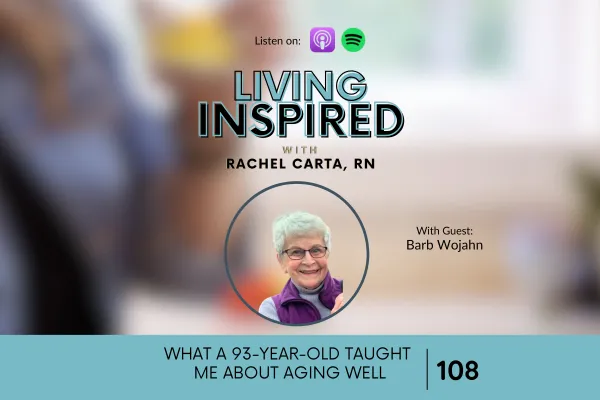
You can listen to the full podcast episode using the embedded player above.
“I get to be an age that most people don’t get to.” - Barb Wojahn
I found my first gray hair in a rest stop. I was on my way to visit my best friend Maria, one of the last times I would ever see her, and I remember standing there thinking, “Oh. Here it is.” There was that little jolt of realizing my body was changing, but almost immediately another thought came in that changed the entire moment for me: Maria will never turn gray. She was 36 when she died.
I have thought about that moment so many times over the years because it permanently changed the way I think about aging. Of course I notice the changes that come with getting older, and I'm human enough to have feelings about them, but I also know that aging is something I get to do. There are people we love who never get the chance.
That idea came up again for me during this week’s podcast conversation with Barb Wojahn, who is 93 years old. I met Barb through an organizing event with our mutual friend Tracy Hoth, and within minutes of meeting her I knew I wanted to talk with her more. She is curious, interested in people, and incredibly engaged in her own life. She spent 52 years volunteering as a bird bander at a local nature center, has been involved in her church for decades, and has run a seniors program for almost 30 years. Now, at 93, she is deciding that it is time to hand some of those responsibilities over and spend more of her time doing the things she wants to do.
What I loved about our conversation was that it really was not about how to live to 93. It became a conversation about how we keep deciding who we want to be as our lives change, and I think that is a question that becomes especially important in midlife.

Who Do You Want to Be Now?
So much changes during this stage of life. Our bodies change, our hormones change, our kids need us differently, our relationships shift, our energy may not be the same, and our priorities often look completely different than they did ten or twenty years ago. Yet many of us are still trying to live according to an old version of ourselves.
Maybe you have always been the woman who does everything, the woman who never says no, the woman who keeps pushing no matter what, or the woman who has always been able to handle more. Maybe there are also things you thought you would be doing by this point in your life, and part of you is still holding onto that picture even though it no longer fits.
Barb said something during our conversation that captured this so well. She was talking about letting go of activities she no longer wants to do, and she said, “It’s hard to say, ‘I’m not that person any longer.’”
That is hard, because sometimes we hold onto an identity simply because we have had it for so long. Barb talked about giving up pastels because she knows she is not going to do that anymore, and ironically, the same week we had this conversation, I threw away a box of oil paints I had kept for about 25 years.
I took a painting class in college and I liked it, so I think some part of me kept those paints because I wanted to be someone who painted. Except I never did. For 25 years I moved that box from place to place, and when I finally threw it away, I realized I was letting go of an identity that never actually became part of my life.
There was nothing wrong with that. I have other things I love and other things I want to spend my time doing, and maybe that is part of growing into ourselves. We are allowed to stop carrying around old versions of who we thought we would become and ask a much more useful question: Who do I want to be now?
Learning Your Capacity
Barb also talked about how difficult it has been for her to learn to say no, not because she does not understand boundaries, but because she genuinely loves people and loves being involved. Her husband used to tell her, “You cannot be two places at one time,” and even at 93 she is still learning to pay attention to her own capacity before saying yes to something else.
This is something I talk about with women all the time because so many of us were never taught to ask, “Do I actually have the capacity for this?” We were taught to get it done, take care of everyone, push through, figure it out, and keep moving. Eventually, though, the body starts giving us feedback.
Maybe you're exhausted, not sleeping well, irritated by everything, more anxious than you used to be, or noticing that your digestion and energy are off. Maybe you simply know that you cannot keep operating the way you always have. That does not necessarily mean something has gone terribly wrong. It may mean your capacity has changed, and instead of fighting that reality, you may need to start listening to it.
Do not wait until you are 93 to learn how to listen to your body and understand your limits. Learn it now, because it changes how you make decisions about your time, your energy, and the things you continue saying yes to.
Connection Matters More Than We Think
Another thing Barb has done throughout her life is stay connected to people. Her mother told her to have friends who were younger than she was, and Barb took that advice seriously. Many of her friends now are younger, and she also told me that she once encouraged her own daughter, who had a demanding career and did not have close women friends, to find two or three women she could really talk to. Her daughter did.
I see the absence of this kind of connection all the time. Women are working, raising families, helping aging parents, managing households, keeping track of schedules, and carrying an enormous amount of responsibility, and somewhere along the way real friendship gets pushed further and further down the list. We tell ourselves we will make time for people when things settle down, but things rarely settle down on their own.
Connection is part of our health, and that is one of the reasons I include it in what I call the Vital Six. Our bodies are affected by whether we feel supported, whether we feel alone, whether we have people we can talk to, and whether we feel like we are carrying everything ourselves. Barb understood the value of that kind of community a long time ago, and her church relationships and friendships have clearly been a big part of her life.

Living With What You Cannot Control
Barb has lived long enough to see a lot. She lost brothers to prostate cancer, her mother had dementia, her husband had vascular dementia after a stroke, and she had colon cancer herself. I asked her how she lives without constantly worrying about what could happen next, and her answer came back to her faith. She said she does not have control over when she is going to go, so instead she pays attention to her body, makes decisions based on what she can handle, and keeps living her life.
There is something very powerful about that because we can spend so much energy trying to control things we simply cannot control. I have carried a line from Dan Millman for years: “Stress happens when the mind resists what is.”
We resist what is all the time. We wish our body were different, we wish our life looked different, we wish we had the energy we used to have, or we wish this stage of life were easier. But when we are constantly fighting where we are, it becomes very difficult to actually be present in the life we have right now.
And this is where the identity piece comes back again, because if we are always trying to get back to who we used to be, we never really get to know the woman we are becoming.
I Get to Be This Age
One of the most powerful things Barb said during our conversation was, “I get to be an age that most people don’t get to.”
That is such a different way of thinking about aging than what we are usually surrounded by, especially as women. So much of the messaging is about getting your old body back, getting your old energy back, looking younger, feeling younger, and somehow finding your way back to a previous version of yourself.
But what if we stopped trying so hard to go backward and became more interested in where we are going?
Maria never got to turn gray. She never got to be 43, or 53, or 93, and every year I get beyond 36 reminds me that this is something I was given the chance to experience.
That does not mean aging is easy. Our bodies change, there can be grief in that, and there can absolutely be frustration and loss. But there can also be gratitude, and both things can be true at the same time.

What This Means for You
You do not have to wait until you are 93 to ask yourself, “Who do I want to be now?”
Not who was I ten years ago, not who do I think I am supposed to be, and not who does everyone else need me to be. Who do I want to be now?
Maybe that means letting go of something you have been carrying for years. Maybe it means saying no more often, making more room for friendships, listening to your body sooner, or changing priorities that no longer make sense for this stage of your life. Maybe it means admitting that something you once wanted is no longer what you want, and giving yourself permission to choose differently.
This week, notice one thing you are still doing simply because it is who you have always been. You do not have to change it or make a big decision about it yet. Just notice it, and then ask yourself whether it still fits the person you want to be now.
Lots of love,
Rachel
Find Rachel on Instagram: @peaceinperimenopause
Rachel's Free Resources:
Mood Swings? Get the 5 minute audio to calm them now. https://rachelcartarn.com/sos
Do you want to understand more of what's changing in your body in midlife and get a few simple tools to feel better now? Get the free guide: The Real Reason You Still Feel Off.
Ready to Talk: Book a Clarity & Relief Session here.