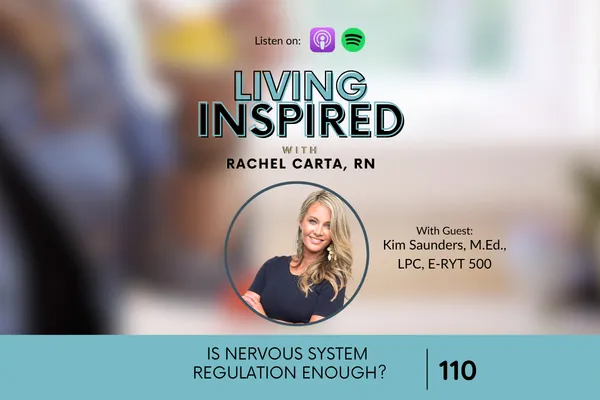
Is Nervous System Regulation Enough?
You can listen to the full podcast episode using the embedded player above.
Calm Is Not the Same as Healed
Nervous system regulation is everywhere right now. We hear about breathwork, grounding, somatic practices, vagus nerve exercises, and helping the body feel safe, and all of these tools can be incredibly helpful. I use many of them myself and with the women I work with because learning how to come out of a heightened stress response is so important. But there's an important question underneath all of this: is calming your nervous system the same thing as healing what is causing the reaction in the first place?
That is what I wanted to explore in a recent conversation with my friend Kim Saunders, a psychotherapist and longtime yoga educator who uses both body-based practices and therapeutic approaches including EMDR and Internal Family Systems, or IFS. Her work sits right at the intersection of something I talk about all the time, which is that the mind and body are not operating separately. What affects one affects the other, and sometimes lasting change requires us to work with both.
Calming the Body Matters, But It May Not Be the Whole Story
Kim has spent decades teaching practices that help people regulate their nervous systems, including breathing, movement, yoga, and other somatic tools that can help increase what is often called our window of tolerance. In simple terms, that means increasing our capacity to experience stress without immediately becoming overwhelmed, shutting down, or moving into a fight-or-flight response.
This kind of regulation matters, especially for women who already feel like their systems are running at full capacity. Learning how to slow your breathing, move your body, notice tension, or create a moment of calm can change the way you respond to stress in real time. What Kim made very clear, though, is that feeling calmer does not automatically mean the original issue underneath that reaction has been resolved.
You can take a walk before a difficult conversation, breathe through a moment of anxiety, journal when you feel overwhelmed, and still notice the same reaction showing up again the next time something touches that sensitive place. Maybe your whole body tightens when someone raises their voice, you immediately feel shame when you make a mistake, or you sit down to rest and feel an almost irresistible need to get back up and be productive. That does not mean the nervous system tools are not working. They may be doing exactly what they are meant to do, while something deeper still needs attention.
Why Old Beliefs Can Feel So True
One of the most helpful parts of my conversation with Kim was her explanation of how old experiences can become connected to beliefs that continue operating long after the original experience is over. She talked about EMDR, a therapeutic approach developed by psychologist Francine Shapiro that uses bilateral stimulation as part of helping the brain process experiences and beliefs that have become connected to memory.
Think about what happens when something difficult or overwhelming occurs when you are young. A child does not have the same perspective, emotional maturity, or life experience that an adult has, so the brain may make meaning out of the experience in a very simple way. A child might come away with a belief like I’m not safe, people leave, something is wrong with me, or I have to keep everyone happy.
Those beliefs are not necessarily conscious. You may never walk around actively thinking them, but years later something happens in your adult life and your body reacts as though the old experience is happening all over again. You can intellectually know that you are safe and still feel unsafe, or know that one difficult conversation does not mean a relationship is ending while another part of you reacts as though abandonment is right around the corner.
Kim uses an iceberg analogy with her clients to describe how much of our internal world may be operating outside of our conscious awareness. In her clinical framing, she describes roughly 10 percent as the conscious part above the water and 90 percent as the habits, beliefs, and patterns below the surface. That 90/10 figure is Kim’s way of teaching the concept rather than a statistic I am presenting as established fact, but the image itself is useful because it helps explain why simply deciding to believe something different does not always create lasting change.
You may consciously tell yourself, I’m allowed to rest, while another part of you has learned that being productive is how you stay valuable, safe, or accepted. You can write the new belief on a sticky note and repeat it every morning, but if an older protective pattern is still operating underneath it, you may continue running into the same resistance.
The Parts of Us That Learned to Protect Us
Internal Family Systems gives us another way of understanding this. In IFS, we look at the different “parts” of ourselves that may show up in different situations. There may be a perfectionistic part, a controlling part, an overwhelmed part, an angry part, a people-pleasing part, or a part that wants to shut everything out when life feels like too much.
The goal is not to label these parts as bad and try to get rid of them. Instead, the work is about becoming curious about why they developed and what they have been trying to accomplish.
Perfectionism is a good example. From the outside, it may look exhausting, and it can absolutely make it difficult to rest, delegate, or feel satisfied with anything you accomplish. But if you look underneath it, that pattern may have developed because doing everything correctly once helped you feel safe or accepted. Maybe achievement earned approval, anticipating everyone else’s needs kept the peace, or being the dependable one helped you feel like things would not fall apart.
That strategy may have served you very well at another point in your life, which is why shaming yourself for having it usually does not help. A much more useful question is, What is this part of me trying to protect? That moves us away from judging ourselves and toward understanding what is actually happening.
Why Midlife Changes the Way You Handle Stress
This conversation feels especially important for women in perimenopause and menopause because so many women reach this stage of life and start asking, “Why can’t I handle what I used to handle?”
For years, you may have been the person who managed everything. You worked, raised children, cared for parents, kept track of appointments, remembered what everyone needed, handled the groceries, managed the schedule, and pushed through exhaustion because there was always something else that had to be done. Then your hormones begin shifting, sleep becomes less predictable, stress feels harder to recover from, and suddenly the strategies that allowed you to keep going for decades do not seem to work the way they used to.
That can feel incredibly confusing, but it may also be a signal that your body no longer has the same capacity to compensate for everything you have been carrying. Things that once stayed below the surface may become more noticeable because you simply do not have the same margin anymore.
This is where I think nervous system work and deeper therapeutic work can complement each other beautifully. The breathing, walking, yoga, meditation, rest, and other ways of helping the body regulate still matter, but sometimes there is also a belief, memory, or protective pattern that deserves to be understood rather than simply managed.
What If You Don’t Remember Where It Started?
One concern people sometimes have about trauma work is that they cannot remember where a particular pattern came from. Some people remember very little of their childhood, while others remember plenty but cannot identify one specific event that explains why they react the way they do now.
Kim explained that you do not necessarily have to remember every detail for the work to be helpful. Sometimes the pattern itself gives you enough information to begin.
Maybe criticism feels much bigger than it seems like it should. Maybe you panic when someone is disappointed in you, conflict makes you immediately shut down, or you automatically start trying to keep everyone happy the second tension enters a room. You may not know exactly where that response began, but you can still become curious about what your system seems to believe is happening in that moment.
You do not have to solve your entire history before you can start understanding yourself differently in the present.
Regulation Can Create Space for Deeper Work
One of the things I appreciated most about Kim’s approach is that she does not treat nervous system regulation and therapy as competing ideas. It is not breathwork or EMDR, yoga or IFS. The body-based practices can help create enough safety and capacity for deeper therapeutic work to happen.
Kim described beginning sessions with movement or breathing before moving into more intensive processing because when the entire system is in a state of alarm, it can be very difficult to explore what is underneath the reaction. Regulation can lower the intensity enough to create some space, and from there, deeper work may become possible.
That distinction matters because wellness culture can sometimes make us feel as though we simply need one more coping tool. Another breathing technique, another meditation, another supplement, another morning routine. Sometimes those things are exactly what we need, but if you keep finding yourself standing in front of the same pattern no matter how many tools you add, it may be worth asking whether you need another way to manage the reaction or whether it is time to understand what is underneath it.
Kim recommends looking for a qualified therapist who understands trauma and works with approaches such as somatic therapy, EMDR, or IFS. Finding the right therapist may take some trial and error, and the relationship itself matters because you should feel that you have agency in the process and enough safety to explore what is there.
Putting Down What You Have Been Carrying
Toward the end of our conversation, I mentioned a Trevor Hall song I have been listening to called “Put Down What You Are Carrying,” because that phrase captures so much of what this work can be about.
We carry old expectations, beliefs, protective patterns, and ideas about who we need to be in order to stay safe, loved, successful, or accepted. Some of those patterns may have helped us tremendously at one point in our lives, so the goal is not to look back and criticize ourselves for developing them. We can appreciate why they were there and still ask whether they are serving us now.
Maybe healing is not about becoming an entirely different person. Maybe part of it is understanding why you became who you needed to become, noticing what your body is still responding to, and allowing yourself to put down some of what you no longer need to carry.
What to Take With You
Nervous system regulation can help your body move out of a heightened stress response, but feeling calmer does not always resolve the belief or experience underneath that response. If you have been using nervous system tools and continue to encounter the same patterns, it may be worth considering whether deeper therapeutic support could help you understand what is driving them.
For now, simply notice the next time your reaction feels bigger than the situation in front of you. Instead of immediately judging yourself or trying to make the feeling disappear, get curious about what your body may be responding to and what that part of you might be trying to protect.
Lots of love,
Rachel
Rachel's Free Resources:
Mood Swings? Get the 5 minute audio to calm them now. https://rachelcartarn.com/sos
Do you want to understand more of what's changing in your body in midlife and get a few simple tools to feel better now? Get the free guide: The Real Reason You Still Feel Off.
Ready to Talk: Book a Clarity & Relief Session here.