
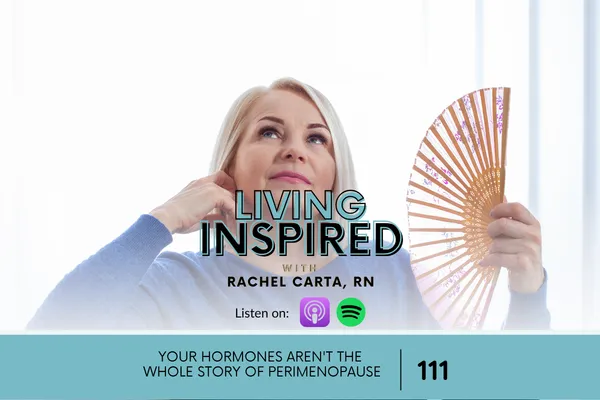
Your Hormones Aren't the Whole Story of Perimenopause
Custom HTML/CSS/JavaScript
You can listen to the full podcast episode using the embedded player above.
This morning, my fourteen-year-old daughter said something that made me stop and look at her. We were talking before school when she said, “Men really have no idea because their bodies feel the same every day, and we feel different every day. We don’t even know what version of ourselves we’re going to get when we wake up in the morning.” She said it so casually, but I thought about it for the rest of the morning.
At fourteen, she had already noticed something women spend years trying to explain. There are days when you feel clear, steady, patient, and completely like yourself. Then there are days when you wake up feeling off before your feet even hit the floor. And in perimenopause, that unpredictability can become one of the hardest parts.
When Your Body Stops Feeling Predictable
You may sleep well one night and then find yourself wide awake at 3 a.m. the next. You may suddenly feel anxious when anxiety has never been part of your story. Your patience gets shorter. Your periods become unpredictable. Your body changes even though your routines have not changed much at all.
The strangest part is often how quickly it can happen. You can feel fine on Tuesday and flattened on Wednesday. A hard night of sleep suddenly takes two days to recover from. A stressful week hits differently than it used to. You may notice more headaches, more cravings, more digestive issues, more irritability, or a general sense that your body has become less forgiving. That is the part I wish more women had been prepared for.
Most of us were never told what this stage might actually look like. Nobody sat us down in our thirties and explained that changing hormones could affect not just our periods, but our sleep, mood, energy, stress resilience, body composition, libido, and the way we feel inside our own skin. So when the changes begin, many women assume something is wrong.
Hormones Matter, But They Aren’t the Whole Story
I'm glad perimenopause is finally being talked about more openly. Women are asking better questions, advocating for themselves, and having more informed conversations about hormone therapy. That is progress. But I also think we need to be careful not to replace one oversimplified story with another.
For years, women were told to simply endure menopause. Now the pendulum can sometimes swing toward the idea that if we just get our hormones right, everything else will fall into place.
Hormones absolutely matter. Hormone therapy can be life-changing for the right person. But it is still one part of a much larger picture. Blood sugar matters. Thyroid function matters. Muscle mass matters. Sleep matters. Blood pressure and cholesterol matter. Digestion matters. Nutrition matters. Stress matters. Recovery matters. Not because you need to become a perfectly healthy person before you are “allowed” to use HRT. That is not the point. The point is that hormones do not exist separately from the rest of the body. They are changing inside a system that already has a history.
Your Body Has a History
Two women can enter perimenopause at the same age and experience it very differently. One may already have years of digestive issues behind her. Another may have blood sugar instability she does not know about yet. Another may be chronically sleep deprived. Another may be caring for aging parents, raising teenagers, working full-time, managing a household, and wondering why she suddenly cannot tolerate stress the way she once did.
Someone else may be dealing with thyroid issues, low iron, insulin resistance, chronic pain, grief, or years of running herself into the ground. This is why I do not hear “I’m exhausted” and immediately assume I know the answer. I want to know when it started. I want to know how she is sleeping, what she is eating, what her days look like, where she is in her cycle, what her labs show, what medications she takes, how her digestion is functioning, and what has been happening in her life.
Sometimes the problem is nutritional. Sometimes it belongs back in the hands of her physician. Sometimes sleep is the obvious weak link. Sometimes chronic stress has been building quietly for years. Usually, the answer is not one thing.
Symptoms Don’t Happen in a Vacuum
I recently worked with a client who had been having more headaches and digestive issues. We could have focused entirely on food. What are you eating? Are you drinking enough water? Are you getting enough protein? Is there something you are reacting to?
Those questions can be useful, but they were not the whole story.
As we talked, she described a workday that had become increasingly stressful. She would spend hours in a heightened state of overwhelm and then move almost immediately into being Mom. There was no real transition between the two. No decompression. No signal to her body that one demanding part of the day had ended before the next began.
Once she began noticing that her headaches often appeared around those especially stressful stretches, the picture became clearer. Her digestion may have been part of the same pattern. That did not mean stress explained everything. It meant we had a more complete story to work with. And that changes the kind of support you can offer.
Why “I Need More Willpower” Is Usually the Wrong Conclusion
I see the same thing happen around food. A woman tells me she cannot stop eating dessert at night, and she immediately makes it a character flaw. She assumes she needs more discipline. Maybe we do need to look at protein, blood sugar, or whether she is eating enough during the day. But I also want to know what happened before she reached for the dessert. Has she been going since 6 a.m.? Has she spent the entire day making decisions, answering questions, helping everyone else, pushing through fatigue, and putting herself last? Has there been one enjoyable moment that belonged only to her?
Sometimes that evening food is not just about hunger. Sometimes it is the first easy, reliable pleasure she has had all day. That does not mean the pattern is automatically serving her. It means the pattern makes sense. And once a behavior makes sense, we can stop fighting it blindly and start looking at what the body and brain may actually be asking for.
Knowing What to Do Is Not the Same as Being Able to Do It
Most women I work with already know a lot about health. They know sleep matters. They know they should move their bodies. They know eating vegetables is probably a good idea. They know chronic stress is not helping them. The problem is not always a lack of information. The problem is that health advice is often given as though women live in a vacuum. Real life is messier than that.
There are children who need rides, parents who need care, jobs that spill into the evening, financial stress, marriages, laundry, groceries, deadlines, hormones, grief, and days when there simply is not enough bandwidth to execute the perfect plan. This is where coaching matters. Not because someone needs another person telling her what to do, but because sometimes we need help seeing why we keep doing what we are doing.
The Vital Six: A Better Way to Pay Attention
One of the tools I use with clients is something I call the Vital Six: sleep, movement, nutrition, hydration, relationships, and stress resilience. It's not a scorecard. It's not six more things to obsess over. It's simply a way to notice patterns.
What is working well right now? What keeps falling apart? What changed before a symptom got worse? Where are you consistently under-supported?
One of my clients has become incredibly good at this. If something comes up between our sessions, she writes it down. By the time we meet again, she is already making connections. She's not waiting for me to explain her own body to her. That is exactly what I want. The goal is not dependence. The goal is self-awareness.
The Patterns Underneath the Symptoms
Sometimes the most important thing we uncover has very little to do with nutrition. Another client realized she had spent years believing she was only allowed to relax once everything was finished. The work had to be done. The house had to be handled. Everyone else had to be okay. Then she could rest. mOf course, that moment never came.
There is always another email, another load of laundry, another problem, another person who needs something. During one of our conversations, she caught herself inside that pattern and realized she could actually feel happy even when life was unfinished. That may sound simple, but it was not small. Because when a woman believes rest must be earned, or that she has to keep everyone else okay before she can care for herself, that belief shapes her nervous system, her choices, and the pace at which she lives. That is part of health too.
The Body You’re Building for the Next Thirty Years
This is the bigger reason I care so much about the midlife conversation. We are not only trying to feel better this month. We are building the bodies we will live in at sixty, seventy, eighty, and hopefully beyond. No one can guarantee an outcome. People who take excellent care of themselves still get sick. Genetics matter. Environment matters. Life happens. But there are things we can influence. We can build muscle. We can pay attention to metabolic health. We can nourish ourselves well. We can take sleep seriously. We can stop pretending that four or five hours a night is something the body should simply adapt to. We can learn how to recover from stress instead of living in it continuously. We can build relationships that support us. Those things matter now, and they matter later.
When Your Body Says, “I Can’t Keep Doing This”
For many women, perimenopause is the first time the body becomes less willing to cooperate with the pace we have been keeping. We have spent years pushing through. We have worked all day and come home to another shift. We have skipped meals because there was no time. We have stayed up too late because ten o’clock was the first hour that belonged to us. We have carried families, businesses, careers, parents, marriages, schedules, and responsibilities while telling ourselves we would slow down later.
Then midlife arrives and the body becomes louder. Sleep starts falling apart. Energy changes. Stress feels different. The tricks that used to work stop working. And maybe the answer is not to push harder. Maybe the answer is to finally pay attention.
Perimenopause Can Be a Turning Point
Perimenopause is often presented as a list of symptoms to manage until we get to the other side. I think it can be more useful than that. It can be the moment we start asking better questions.
How am I sleeping?
How am I eating?
How strong is my body?
How stable is my metabolic health?
How much stress am I carrying?
Do I ever recover from it?
What patterns am I repeating?
What do I want the next half of my life to feel like?
Those questions matter because many women reach midlife having spent years taking care of everyone else while assuming their own bodies would continue to keep up. Eventually, that becomes a difficult bargain to maintain.
Why I Created the Living Inspired Life Lab
This is the work behind the Living Inspired Life Lab. I created it because information is not the thing women are missing anymore. Information is everywhere.
You can Google nearly anything. You can listen to a podcast, follow another health account, or ask AI what to eat or what a lab marker means.
What is harder is knowing what actually matters for you. It's harder to see which symptoms may be connected, which habits are actually moving the needle, which areas need medical attention, and which part of your life deserves your attention first.
That is the work I love.
The Life Lab brings together sleep, stress, nutrition, movement, digestion, relationships, mindset, and the patterns that shape how we care for ourselves. It combines education, coaching, and accountability so women can stop chasing one symptom at a time and begin understanding the bigger picture.
The group begins September 21, during Perimenopause Awareness Month.
You Do Not Need to Fix Everything at Once
If you are reading this and thinking, “I know something needs to change, but I do not even know where to start,” do not start by making a list of everything you are doing wrong. Start by noticing what is taking the greatest toll. Maybe it is sleep. Maybe you are under-eating all day and crashing at night. Maybe you move from one role to another without a single pause. Maybe your stress level has become so normal that you no longer recognize it as stress. Maybe you simply need help figuring out what deserves your attention first. That is enough. You do not need forty-seven new rules.
You need a clearer understanding of your own body, your own patterns, and the next right place to begin. My daughter was right. We do not always know which version of ourselves we are going to wake up to. But perhaps the goal was never to feel exactly the same every day. Perhaps the goal is to know ourselves well enough that when something changes, we know how to listen.
Lots of love,
Rachel
Rachel's Free Resources:
Mood Swings? Get the 5 minute audio to calm them now. https://rachelcartarn.com/sos
Do you want to understand more of what's changing in your body in midlife and get a few simple tools to feel better now? Get the free guide: The Real Reason You Still Feel Off.
Ready to Talk: Book a Clarity & Relief Session here.