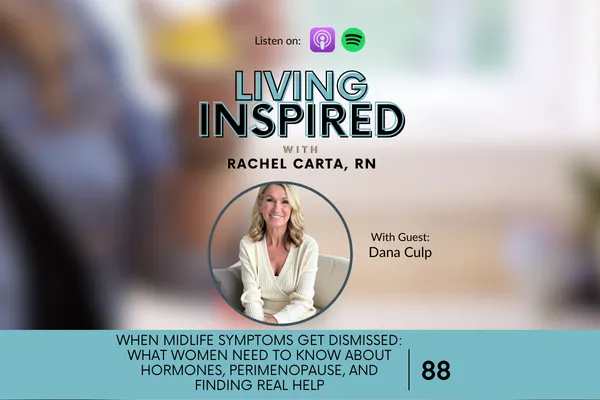
When Midlife Symptoms Get Dismissed: What Women Need to Know About Hormones, Perimenopause, and Finding Real Help
When Midlife Symptoms Get Dismissed: What Women Need to Know About Hormones, Perimenopause, and Finding Real Help
There’s a moment so many women hit in midlife where something just starts to feel off.
You might still be doing all the things you’ve always done. You’re showing up for work, taking care of people, keeping the house moving, trying to be present, trying to stay on top of your health, and yet your body feels different. Your moods feel different. Your patience feels thinner. Your sleep is off. Your brain feels foggy. The weight that used to come off with a few small changes suddenly won’t budge.
And because so many of these changes can feel subtle at first, it’s easy to wonder if it’s just stress, just life, just being busy, just getting older. But for many women, that’s not the whole story.
In this conversation on the podcast, I sat down with Dana Culp, founder of Thrive Midlife Medicine, to talk about what’s really happening in perimenopause and menopause, why so many women get dismissed when they ask for help, and how to start advocating for the care they actually need.
When You Don’t Feel Like Yourself Anymore
One of the things I appreciated most about Dana is that she came to this work through her own lived experience.
She had a successful career, a full life, and all the responsibilities so many women carry. Then things started to shift. She began noticing mood changes, brain fog, weight gain, trouble sleeping, and a growing dissatisfaction that was hard to explain. Even with all of her medical background, she didn’t immediately connect the dots. Like so many women do, she thought maybe she just needed to try harder, push through, and keep going.
When symptoms build slowly, they can be hard to name. You may know something is different, but not know exactly how to describe it. It’s not always dramatic in the beginning. It can feel more like a quiet unraveling. A shorter fuse. Less resilience. More effort required just to feel baseline okay.
Then eventually, there’s a tipping point.
For Dana, one of the more measurable signs was rising blood pressure. That was what finally pushed her to seek help. But even then, what she found was what so many women have experienced themselves: dismissal, outdated care, and a lack of real conversation about hormones.
She was told this wasn’t what was going on. She was handed a blood pressure pill. Later, she was given outdated treatment from another provider. Even after seeking highly regarded specialists, she still found herself facing a one-size-fits-all approach instead of thoughtful, individualized care.
And honestly, that’s where so many women begin to feel a kind of hopelessness. Not because they’re imagining their symptoms, but because they finally gather the energy to ask for help and aren’t met with the kind of support they need.
Why So Many Women Struggle for So Long
When we talked about why women often go years without real answers, Dana named something I see all the time too. Women are used to carrying a lot.
We take care of children, partners, careers, homes, family members, aging parents, schedules, emotions, logistics, and all the invisible labor in between. We get very good at pushing through. We put ourselves on the back burner and tell ourselves we’ll deal with it later, when things calm down, when there’s more time, when someone else needs us less. But that later often turns into years.
Then on top of that, many of the symptoms of perimenopause are easy to second-guess. Mood shifts. Anxiety. Brain fog. Trouble sleeping. Feeling less emotionally steady. A sense that your body just isn’t responding the way it used to. These things are deeply real, but they’re not always easy to measure, and that makes them easier to dismiss, both by ourselves and by the people we go to for help.
The third piece, and this is a big one, is training.
Dana shared that many providers simply were not trained well in this stage of women’s health. Even many OB-GYNs received very little education on perimenopause and menopause care. Their training often focused much more on reproduction than on the hormonal transition that every woman, if she lives long enough, will eventually move through. That gap in knowledge has real consequences.
It means women are often told to eat less and move more. They’re told it’s stress. They’re told to come back later. They’re handed a medication for one symptom without anyone stepping back to ask what larger pattern might be driving what’s going on.
The Problem With Treating Symptoms One by One
This is where Dana’s perspective and mine overlap so much. In my work, I’m always asking: what’s the bigger picture here? What are the root causes behind these symptoms? What’s happening upstream?
Hormones can absolutely be one important piece of that picture, especially in perimenopause and menopause. But they are not the only piece. Nervous system dysregulation, blood sugar imbalance, poor sleep, gut issues, thyroid concerns, chronic stress, inflammation, and nutrient depletion can all be interacting at the same time. That’s why symptom-by-symptom care so often leaves women feeling frustrated.
A sleeping pill might not address why your nervous system is so activated. An antidepressant might not address wildly fluctuating hormones, unstable blood sugar, or poor sleep architecture. Advice to simply exercise more may completely miss the fact that your body is already overwhelmed and under-supported.
Real care has to look at the whole person.mThat doesn’t mean every woman needs the same approach. Quite the opposite. It means we need individualized care that asks better questions, looks at the whole story, and helps women understand what their body is asking for now.
What Perimenopause Actually Is
A lot of women hear the word menopause, but what often gets missed is the long stretch of time before menopause called perimenopause.
Menopause itself is defined as going 12 months without a menstrual cycle. Perimenopause is the time leading up to that, and it can begin years earlier than many women realize, sometimes up to 10 years before the final period. That means some women may start noticing changes in their late 30s or early 40s and not realize hormones could be part of the picture.
Early perimenopause can be subtle. Maybe your sleep changes. Maybe you start gaining weight more easily. Maybe your moods feel a little less steady. You may not be sure whether what you’re feeling is hormones, life stress, or both.
Later perimenopause is often where things become harder to ignore. Hormones may fluctuate more dramatically, and that can affect mood, anxiety, sleep, cognition, and resilience in a much bigger way. Dana described this as a particularly tough stage for many women, and I think that’s such an important point. If you’ve felt like the things that used to help you feel grounded don’t work as well anymore, that doesn’t mean you’re doing something wrong. It may mean your body is in a different season and needs different support.
Why Hormone Therapy Feels So Confusing
There is still so much fear and misinformation around hormone therapy. Dana explained that a lot of that fear traces back to messaging that came out about 25 years ago after a large women’s health study was widely misinterpreted in the public conversation. Even though the story has since been revisited and challenged many times, the original fear stuck. For many women, the message they absorbed was simple: hormones are dangerous. That fear is still shaping conversations today.
And when women don’t get clear, updated information, they’re left trying to make important decisions from a place of confusion.
One of the distinctions Dana talked about was the difference between synthetic hormones and bioidentical, or body-identical, hormones. Her point was that the conversation about hormone therapy needs nuance. The forms used in the past are not the same as the options many knowledgeable practitioners use now. That matters, both for symptom support and for long-term risk and benefit.
It also matters that hormone therapy is not just about reducing hot flashes. That’s one of the things I really wanted listeners to hear. Hormonal shifts can affect mood, sleep, cognition, weight, sexual health, cardiovascular health, bone health, and more. So this is not a shallow conversation about a few inconvenient symptoms. This is about women understanding what is changing in their bodies and having the chance to make informed choices with good support.
Hormones Matter, But They Aren’t Everything
I loved that Dana said something I say in my own way too: hormones are not the cause of everything, and they are not the cure for everything. That kind of balance is important. Because yes, hormones matter. They can make a huge difference for some women. But no one is served by a one-size-fits-all plan, whether that plan is “everyone needs hormones” or “no one should use hormones.”
What women need is thoughtful assessment. They need someone looking at blood sugar, thyroid, metabolic health, nervous system stress, sleep, lab markers, symptoms, history, and the full context of what’s going on. They need someone who understands that perimenopause may be part of the picture, while also recognizing that lifestyle patterns, stress load, and foundational health habits still matter deeply.
This is something I care so much about in my own work. If blood sugar is all over the place, if a woman is barely eating during the day and then crashing at night, if her nervous system is constantly in overdrive, if she’s exhausted and undernourished, then adding one intervention without looking at the rest of the picture may only go so far.
The goal is never just symptom management in isolation. It’s helping women understand what actually moves the needle for their body.
How to Advocate for Yourself at the Doctor’s Office
A lot of women walk into a medical appointment already feeling unsure. They assume the provider has the answers and they have to just hope they ask the right questions. But Dana reminded us that self-advocacy matters, and that it’s okay to vet a provider before investing your time, money, and energy. She shared a few simple but powerful questions women can ask.
Ask About Training
You are allowed to ask what kind of training a provider has in perimenopause and menopause care. That's not rude. It's wise. A knowledgeable provider should be able to answer that clearly, and a good one will not be offended by the question.
Ask How They Individualize Care
This is a big one. If the approach sounds the same for everyone, that’s a red flag. Women deserve care that takes their specific symptoms, history, health markers, and goals into account.
Ask How Progress Will Be Assessed
What does follow-up look like? How will you know whether a plan is helping? How often will things be reevaluated?
That question matters because hormones fluctuate, symptoms shift, and healing is not always linear. Good care should include ongoing assessment, not just a prescription and a vague “see you next year.”
Dana also suggested something very practical that I think more women should know. When you call to make an appointment, ask the front desk staff whether that provider regularly treats women in menopause or perimenopause. They often know. That one question could save you a disappointing visit.
There Is So Much Hope Here
One of my favorite parts of this conversation was the way Dana talked about hope. Not forced positivity. Not pretending everything is easy. Real hope. The kind that says: if one provider dismisses you, that does not mean your symptoms aren’t real. It may simply mean that person does not have the knowledge you need. That reframe matters so much because it helps women stop internalizing dismissal as truth.
You are allowed to keep looking. You are allowed to ask better questions. You are allowed to believe that feeling better is possible. You are allowed to seek care that treats you like a whole person instead of a list of unrelated complaints.
And maybe just as importantly, this time of life does not have to be framed as a slow decline. It can be a powerful turning point. Yes, it may ask more of us. Yes, it may require us to care for ourselves in a deeper and more intentional way. But it can also be a season where women get clearer, stronger, and less willing to settle for care that misses the mark. There is grief in that sometimes, but there is also power.
And if you’re in the middle of this season right now, wondering why you feel so different, I hope this reminds you that there are reasons. There are patterns. There are people who understand this space. There are better questions to ask. There are next steps you can take. Most of all, there is support.
Final Thoughts
What stood out most in this conversation is that women do not need more dismissal. They need education. They need individualized care. They need someone willing to zoom out and look at the whole picture.
Whether hormones end up being part of your path or not, understanding what’s happening in your body changes everything. It helps you stop blaming yourself. It helps you respond with more clarity. It helps you make decisions from a place of grounding instead of fear. That’s a very different way to move through midlife. And it’s one I want more women to have access to.
If this conversation spoke to you, share it with a woman in your life who may need it too. These are the conversations that help us feel less alone, more informed, and more hopeful about what’s possible.
Lots of love,
Rachel
About Dana
Dana Culp is the founder of Thrive Midlife Medicine, a virtual medical practice focused on women in perimenopause and menopause.
Website: https://www.thrivemidlifemed.com/
Instagram: https://www.instagram.com/thrivemidlifemed/
Facebook: https://www.facebook.com/thrivemidlifemed
LinkedIn: https://www.linkedin.com/company/thrive-midlife-medicine/
Additionally, we’d love to offer your listeners a free consultation and a free class:
https://thrivemidlifemedicine.cal.com/thrivemidlifemedicine
https://www.thrivemidlifemed.com/event
Rachel's Free Resources:
Mood Swings? Get the 5 minute audio to calm them now. https://rachelcartarn.com/sos
Do you want to understand more of what's changing and get a few simple tools to feel better now? Get the free guide: The Real Reason You Still Feel Off.
Ready to Talk: Book a Clarity & Relief Session here.