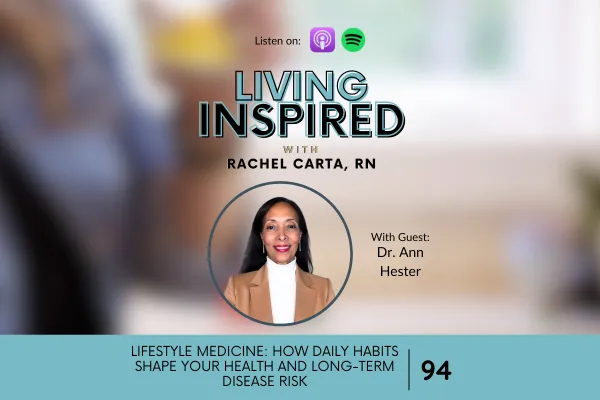
Lifestyle Medicine: How Daily Habits Shape Your Health and Long-Term Disease Risk
If you want to hear the full conversation, you can listen to this episode of the Living Inspired Podcast using the player above.
Most Women Have Been Taught to Focus on the Wrong Things When It Comes to Their Health
Most women I talk to are trying to feel better, but they’ve never been shown how all of it actually connects. They’re trying a new supplement, a new diet, a new test, a new doctor. There’s effort, and a lot of it, but without a clear framework, it’s easy to feel like you’re doing everything and still not getting answers.
That’s the gap.
And it’s exactly what this conversation with Dr. Ann Hester brought into focus. (You can listen to the full episode with the player above.)
Dr. Hester is a double board-certified physician in internal medicine and lifestyle medicine, and what stood out immediately is how little of this was actually taught in her medical training. She shared that she had about two hours of nutrition education in four years of medical school, which explains a lot about why so many women feel like they’re getting partial answers instead of the full picture. Add to that the lack of training in perimenopause and menopause and it's easy to see why so many women are frustrated.
The System Was Built to Treat Disease, Not Understand It
Traditional medicine is incredibly valuable, but it was built around identifying disease and matching it with a treatment. That works well in acute situations, but it often falls short when someone is dealing with ongoing symptoms that don’t fit neatly into one diagnosis.
What gets missed is everything leading up to that diagnosis. The patterns. The daily habits. The environment someone is living in. That’s where lifestyle medicine and functional nutrition counseling comes in. It shifts the focus in a way that most people have never been taught to think about.
“Your daily habits change your hormone levels, your inflammation, everything,” - Dr. Ann Hester
That’s not a small statement. That’s a completely different way of understanding your body.
Lifestyle Isn’t a Side Note. It’s the Driver.
One of the biggest misconceptions I see is that lifestyle is something you “clean up” after something goes wrong. Eat better, move more, reduce stress.
But what this conversation makes very clear is that lifestyle isn’t the add-on. It’s the driver. The way you eat, sleep, move, and respond to stress is shaping what’s happening inside your body every single day, whether you’re paying attention to it or not. This is influencing your energy, your mood, your digestion, your hormones, and your long-term health.
And yet, most women are never shown how to look at their life through this lens. They’re told what to take. They’re told what to avoid. But they’re not taught how to understand patterns.
The Biggest Lie: “It’s Just Genetic”
This is another area where I think we’ve been misled. A lot of women believe that if something runs in their family, it’s just their path, and there’s only so much they can do about it. That belief alone keeps people stuck.
But what Dr. Hester explained, and what we see in research, is that genetics may load the gun, but lifestyle pulls the trigger.
“Your daily habits flip the switch toward disease or away from disease.”
That means your habits are interacting with your genetics every day in small, consistent ways that add up over time. That’s not about blame. That’s about understanding where you actually have influence.
Why Change Feels So Hard (And What Most People Get Wrong)
If this all sounds simple, that’s because it is. But simple doesn’t mean easy. One of the most honest parts of this conversation was acknowledging how hard it is for people to actually make these changes, even when they know what to do. This isn’t about willpower. It’s about patterns, environment, and nervous system capacity.
Most people think they need to overhaul their entire life to feel better. That’s where they get stuck. Because when everything feels like it needs to change, nothing changes.
The Shift That Actually Works
This is where I want you to focus, because this is what actually moves the needle. You don’t need to change everything. You need to change something, and you need to do it consistently.
Dr. Hester talked about micro habits, and this is something I use all the time with my clients. Small, specific changes that build over time. “One bite at a time.”
That might look like:
drinking one more glass of water today
adding a vegetable to one meal
going for a short walk after dinner
getting to bed just a little earlier
These aren’t dramatic changes, but they are powerful because they’re sustainable. And when something is sustainable, it actually sticks.
What This Means for You
If you take anything from this conversation, let it be this. You don’t need a completely new plan. You need a better understanding of what’s already influencing your body every day. And then you can start small. Not perfectly. Not all at once. Just small enough that you can actually follow through. Because once your body starts responding, everything begins to feel more possible.
Final Thought
You can live a long time. But how you feel during that time is not guaranteed. Energy, clarity, independence, and quality of life are shaped by the patterns you’re living in now, not just the care you receive later. And that’s the part most people don’t think about until it’s too late.
If You Want Support
If you’re starting to see how all of this connects, but you’re not sure where to begin, this is exactly the work I do with my clients.
We look at your full story, identify patterns, and create a plan that actually fits your life so you can feel calm, confident, and like yourself again.
You can learn more here:
https://rachelcartaRN.com
Resources Mentioned
Dr. Ann Hester’s website: https://ptrreset.com
Free sneak peek course + “30 minutes for 30 years” sessions: available on her site above
Rachel's Free Resources:
Mood Swings? Get the 5 minute audio to calm them now. https://rachelcartarn.com/sos
Do you want to understand more of what's changing in your body in midlife and get a few simple tools to feel better now? Get the free guide: The Real Reason You Still Feel Off.
Ready to Talk: Book a Clarity & Relief Session here.