The Mouth-Body Connection: What Your Gums Are Telling You About Your Hormones
Custom HTML/CSS/JavaScript
You can listen to the full podcast episode using the embedded player above.
You already know the drill: brush twice a day, floss, see the dentist every six months. What nobody told you is that the inflammation in your gums doesn't stay in your mouth and it's connected to your blood sugar, your gut, and your hormones.
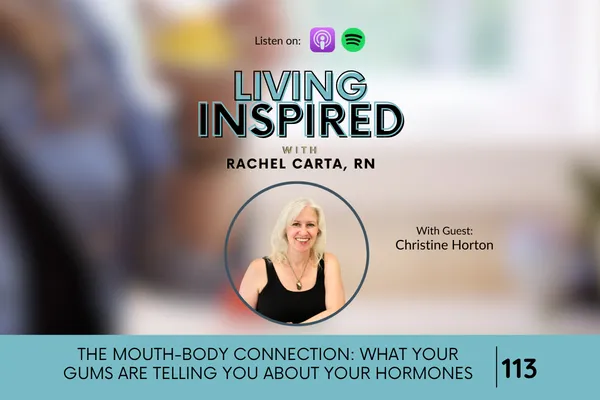
In Episode 113 of the Living Inspired podcast, I sat down with Christine Horton, dental hygienist, health coach, and Programs and Advocacy Co-Director of the PCOS Awareness Association, to talk about a field most of us have never heard of: oral systemic health.
I came away from this one rethinking my own nightly routine. Here's what stood out.
Your Mouth Isn't Separate From The Rest Of You
Conventional medicine keeps everything in tidy boxes. Something wrong in your mouth? Dentist. Something wrong in your body? Doctor. Almost nobody is looking at how the two talk to each other.
Christine came to this work through her own health story. Diagnosed at 17 with what was then called PCOS, she spent decades looking for answers she wasn't getting in the doctor's office, while working as a hygienist the entire time.
"One thing that you find with chronic disease is the way that it presents when you're diagnosed and what that looks like 10 years down the road, 20 years down the road, can be very different."
What she found were overlaps everywhere. Women with PCOS/PMOS have a higher incidence of periodontal disease. Sleep apnea sits squarely in both the dental and medical worlds. And there's a well-documented relationship between gum health and insulin resistance, one of the most common features of the condition.
Her reason for talking about it publicly is simple: it gives women their power back.
"I think sometimes when you have a chronic illness, it's like, 'Well, this is what it is, and there's really nothing you can do.' And I want women to know that that's not true."
PCOS is Now PMOS — And The New Name Matters
If you've seen "PMOS" showing up lately and wondered whether you missed something, you didn't. In May 2026, an international consensus of medical and patient organizations formally renamed polycystic ovary syndrome to polyendocrine metabolic ovarian syndrome (Endocrine Society).
Christine walked us through why each letter earns its place:
P — Polyendocrine. Multiple hormones, not one gland.
M — Metabolic. The piece that was missing. Insulin resistance, blood sugar, metabolic health.
O — Ovarian. Still there, because it remains a leading contributor to female infertility.
S — Syndrome. It does not show up the same way in any two women.
That last letter is the one that validates so many women's experience. Diagnosis requires meeting two of three criteria — so four women in a room can share one thread in common and differ on everything else.
"When we take a condition that was primarily looked at as a reproductive condition, and we now have it affecting multiple systems in the body, and we say that it's lifelong — that changes what you get for funding, what you get for research."
There's a roughly three-year bridge while billing codes, charts, and systems catch up, so you'll hear both names used interchangeably for a while.
And the scale is staggering. Roughly one in eight women are affected, and an estimated 70% don't know they have it (World Health Organization).
"If we can't name what it is, how do we know how to get treatment for it?"
Her second reason for the work is personal: she has daughters, and there's a genetic link.
"If any of them were to be diagnosed, I want them to have a different story. Not just, 'This is what you have. See me if you wanna have kids someday, but you probably won't be able to.' That's not healthcare."
I felt that one in my chest. The more I learn about the lack of funding and research in women's health, the madder I get, in the most useful way.
The Finger Analogy Reframe
Imagine you walk into a doctor's office with an infected finger. It bleeds sometimes. Someone mentioned it might be affecting the bone. No physician on earth responds with, "Let's cut it off." They treat it as serious, because untreated infection affects the entire body.
"When that happens in the mouth, we don't get that same response. They're like, 'I got other teeth. Just pull the tooth.' But it doesn't change that we have an infection."
All disease stems from inflammation, and the body doesn't care which zip code the inflammation lives in. There's a second mechanism, too: diseased gum tissue becomes thin and porous, so oral bacteria pass directly into the bloodstream and travel everywhere. Christine pointed to the strong documented correlations between oral disease and cardiovascular disease, diabetes, Alzheimer's, and osteoporosis.
The trap: pain is not your early warning system.
"If something doesn't hurt, it doesn't mean that there's not inflammation happening. If you brush your teeth, if you floss, and you spit and there's a tiny bit of pink — that's a sign."
The Oral Care Routine That Matters
We got into the nitty-gritty, because I always do the things better when I understand why they matter.
See a dental professional every six months. Period. Gum disease is diagnosed, not self-detected and those numbers your hygienist calls out (three, two, three, four) are six measurements per tooth, mapping where your tooth meets your gum. Ask what they mean. Most of us never do.
Brush twice a day and make the night one non-negotiable.
"At night it's warm, it's dark, and nothing moves. What's the perfect environment for bacteria?"
Good news for busy women: your nighttime routine doesn't have to happen right before bed. Do it whenever you've finished eating and drinking for the day.
Interdental cleaning. That's the dental term for cleaning between teeth, ideally floss. Water flossers are an alternative, and the data is debated, but Christine's philosophy is refreshingly practical: "If you're doing nothing, let's do something and see where we can get you."
Mouthwash, reconsidered. The old goal was to kill all bacteria. That's out of date, because the easiest bacteria to kill are the good ones. If your bottle advertises killing a percentage of bacteria, ask your dental professional about a neutralizing mouthwash instead — pH in the mouth affects cavity rates.
Tongue scraper: yes. Her strongest blanket recommendation of the whole conversation. Your tongue has grooves and pits that harbor a lot of bacteria, and you want to disrupt it.
Two Important Connections
Saliva testing. Increasingly common in dental offices: a swab or a spit sample, sent off, and you get a report of which bacteria live in your oral microbiome and at what levels. Certain species are strongly correlated with disease elsewhere in the body, and when levels come back outside the normal range, there are dental interventions that change those numbers.
The gut connection. If you're doing all the gut work, probiotics, kombucha, the elimination protocols, and nothing is shifting, Christine's question is: has anyone looked in your mouth?
"What's the beginning of our digestive tract? If we haven't even looked at bacteria in the mouth or the health of the mouth, it can be a game changer for helping your gut health."
Why This Is A Hormone Story, Not Just A Dental Story
Here's the piece that brings it full circle for those of us in perimenopause and menopause.
Christine described a patient with genuinely excellent home care and clean checkups for years. She gets pregnant, comes back, and her gums are puffy and sensitive. Nothing changed but a hormone.
If pregnancy hormones can visibly change gum tissue, so can the hormonal shifts of perimenopause — and so can a polyendocrine, metabolic condition like PMOS. Better yet, the relationship runs both directions.
"If we can make an improvement in your oral health, it can improve your A1C or your blood sugar number. And vice versa."
Bidirectional means every small change counts twice.
Small Hinges Swing Big Doors
If you are a woman who does everything for everyone, please hear this part. Christine and I agreed completely: the total-life-overhaul approach is a myth, and for women with hormonal or metabolic conditions it can actively backfire.
"If you have a hormone metabolic condition, and you decide you're gonna go on this specific diet, and you're gonna exercise seven days a week for two hours a day — it's gonna backfire. Your body is already doing so much. You already have high inflammation, high cortisol, high androgens."
Social media hands us a checklist and promises an outcome. It can't account for your individual response. Intermittent fasting is a perfect example — genuinely helpful for some women, genuinely destabilizing for others whose blood sugar and hormones are already dysregulated.
There's also a subtler cost to the tracking culture. I have multiple clients who wake up and immediately check their sleep score before they've even checked in with themselves.
We're not actually living in these bodies anymore. We're managing them. We're judging them. We're tracking them. And we're not really in them.
I asked Christine for the one thing she'd leave us with.
"The first step always is to get in tune with your body. What is your body telling you? Because if you don't even know what's happening, you can't move forward. Acknowledgement within your body is number one."
For women who have spent years pushing the exhaustion, the headaches, and the symptoms to the side to keep being everything for everyone, that's the work. And you don't have to wait until everything is resolved to feel like yourself again. You can find that moment right here, right now, and let your life grow bigger than the diagnosis.
Ready To Find Your Small Hinge?
If you're in perimenopause or menopause and you're tired of piecing it together alone, guessing which protocol applies to you, wondering why the thing that worked for everyone else made you feel worse, that's exactly the gap I fill.
I'll listen to your whole story, and together we'll find the one small change that swings the big door.
Book a call with me and let's talk about what's actually going on in your body.
Find Christine Horton
Health coaching: fusionhealthcoach.com
Social media: @pmospcosglowhygienist on Instagram, YouTube, and Pinterest
PCOS Awareness Association: pcosaa.org — including the monthly support groups she co-hosts on second Wednesdays
PCOS CON: September is PMOS/PCOS Awareness Month, and the one-day virtual conference with experts from around the world is at pcoscon.org
Listen to the full episode of Living Inspired, and if this was useful, share it. Women's health progress right now is grassroots. We get better care by passing the information to each other.
Rachel's Free Resources:
Mood Swings? Get the 5 minute audio to calm them now. https://rachelcartarn.com/sos
Do you want to understand more of what's changing in your body in midlife and get a few simple tools to feel better now? Get the free guide: The Real Reason You Still Feel Off.
Ready to Talk: Book a Clarity & Relief Session here.