The Money Story Your Body Is Still Carrying
Custom HTML/CSS/JavaScript
You can listen to the full podcast episode using the embedded player above.
What sentence about money did you hear so many times growing up that it became part of you?
For me, it came from my dad. He used to say it all the time: "If a man don't work, a man don't eat." I didn't know it then, but that line was being written into me like code. To this day, taking time off takes real psychological work for me, because somewhere deep in my body, rest still feels like a threat to survival. Alongside it runs another one I've had to look at hard: there's never enough. That belief is why I've almost always had more than one job. And when I started doing the work on scarcity, I realized it hadn't only shaped my bank account. It had shaped my sleep, my stress, my relationships, and the way I treated my own body.
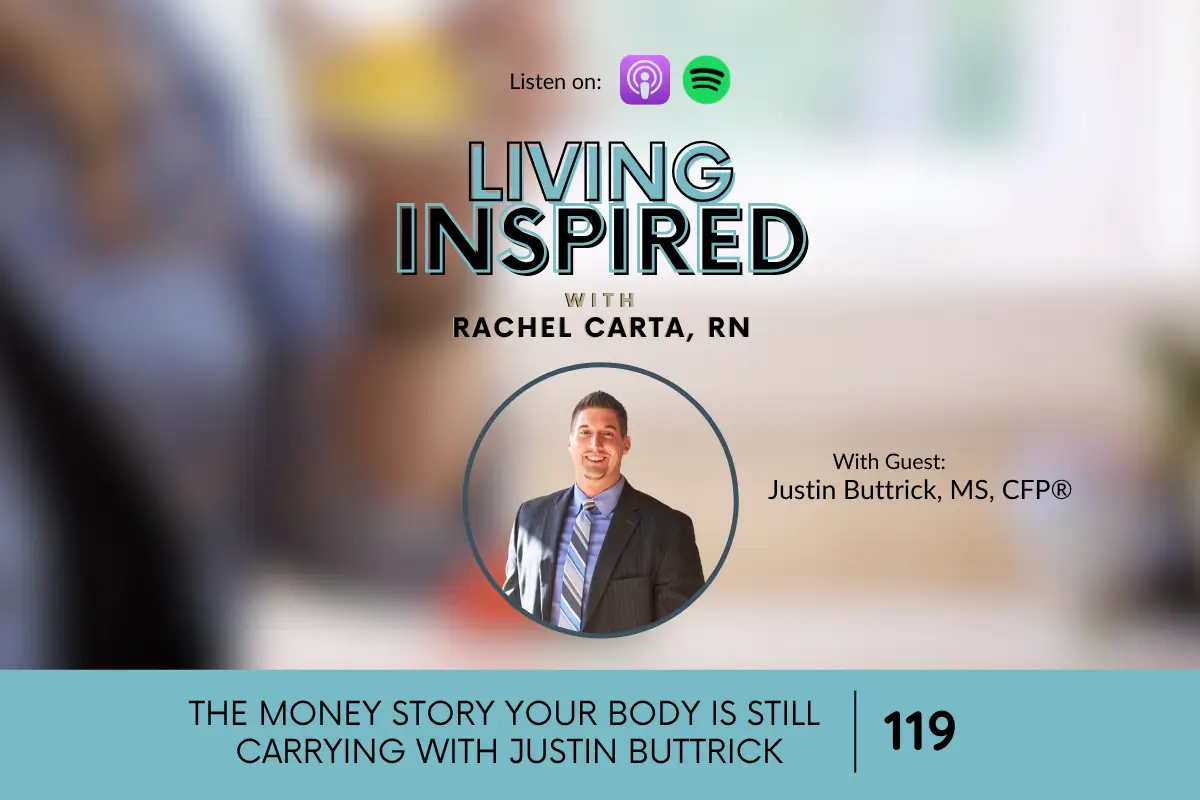
That's why I wanted this conversation on the podcast. In this episode, I sat down with Justin Buttrick, founder of Vision Wealth Advisors, an independent financial advisory firm in Pennsylvania that helps retirees and people preparing for retirement make smarter decisions about investing, taxes, and retirement income. Every time I talk with Justin about my own finances, I walk away calmer and more grounded. Money isn't a topic we usually cover in the health world. I think that's a mistake, because financial stress lives in the body.
The Scripts Running in the Background
Justin introduced a concept from his master's program in financial planning that changed how I see my own patterns: money scripts. Think of an actor reading lines. A money script is a belief about money that runs automatically, and most of them, he explained, are rooted in childhood, in your first experiences with money, and sometimes in painful ones. If you grew up hearing that money is the root of all evil, you might hold yourself back from pursuing it. If you're a high achiever, you might be living out the script Justin named for himself: my self-worth equals my net worth.
I see this belief in so many of the high-achieving women I work with. It doesn't always show up as money. It shows up as a goalpost that keeps moving. Justin described clients who save $500,000 and immediately need a million, then reach a million and need more. The number changes, but the feeling underneath never does. In my practice, I see the exact same pattern with health. The woman who finally gets her energy back and immediately adds three new goals, because rest still feels unearned. We must do intentional work to see these scripts and rewrite them.
What Stress Does to the Script
Stress amplifies your money scripts. Whatever is running in the background gets louder the moment life gets harder. Some people respond by hoarding money in savings and never letting it work for them. Others go the opposite direction and find relief in the buy button.
I want you to understand why this happens in your body. When your nervous system perceives a threat, it shifts into a sympathetic, protective state. That threat doesn't have to be a bear. A bill you're afraid to open, a retirement number you can't face, or a headline about the economy can all register the same way. In that state, your body prioritizes short-term survival over long-term planning. Cortisol stays elevated, which can drive blood sugar swings, cravings, and the kind of sleep where you wake at 3 a.m. with your mind already racing. And from that place, you reach for whatever feels familiar and safe. That's exactly when the old script takes the wheel.
So when you notice yourself spending to soothe or clutching every dollar out of fear, I want you to get curious instead of critical. Your body is doing what it was designed to do under threat. The work is to help it feel safe enough to choose differently.
The Feed Is Not Your Advisor
When I asked Justin about the biggest mistakes people make when they're operating from fear, he didn't hesitate. The 24/7 news cycle. We now carry a supercomputer in our pockets that feeds us fear around the clock, and he sees people make emotional financial decisions because of it all the time. The other trap is the shiny object: the rental properties or the side business someone online insists you need, stated with so much confidence that it must be true.
I see this in health constantly. My mom regularly sends me things and asks, "Is this a good thing?" More often than not, I'm telling her to stop looking at it. Justin and I talked about how many of us grew up trusting the evening news as the authority, and now we carry that same trust into a feed where everyone is an authority on everything. Confidence is not credibility. Whether it's your money or your hormones, vet the source before you let it move you.
Learning about Money
Justin told a story about his grandmother. When his grandfather passed away, she didn't know how to pump gas or write a check. He still sees versions of this with couples today, where one person handles everything and the other has no idea what the plan is. His advice was simple. Stay involved. You don't have to love finances, but you should know the broad strokes.
Then he said something I want every woman reading this to hear: "If somebody's explaining it to you, they should be able to explain it simply, or they don't understand it well enough to explain it to you. It's not your fault for not understanding it." Let me repeat that. It's not your fault for not understanding it. I feel the same way about health. If a provider can't explain your labs in words that make sense to you, that isn't a reflection of your intelligence.
For couples, Justin recommends a standing monthly money meeting, because if you don't schedule it, it never happens. Without it, everything runs on assumptions. I did something similar recently for the tasks I handle for my siblings. Instead of carrying it around all month, I gave it a day on my calendar with a name. It's also the perfect day for a money conversation. In our marriage, I've always been the saver and my husband the spender, and over the years we've taught each other. He helps me spend, and I help him save. When those conversations happen on a set day, they stop being emotionally loaded and become what they should be: here are the numbers, here's where we are, here's where we're going, and here's what we value. For us, giving is one of those values, and it comes off the top every month.
When money has a scheduled place in your week, it stops living in your nervous system.
Every Dollar Gets a Job
If you're reading this and feeling behind, Justin's answer was clear. It's never too late. You can't change the past, and dwelling on what you wish you'd done ten years ago is just negativity that keeps you stuck. He hears "I wish I'd come to you years ago" all the time, and he believes people can make up lost ground faster than they think.
He shared three habits that create the biggest long-term difference. First, know where your money is going. Give every dollar a job. Second, be intentional about what you're trying to do, because a budget without a plan is just organization. Your goal might be paying down debt, buying a house, or starting to invest, and it's personal to your stage of life. Third, never stop learning.
When Justin laid these out, I realized they're the exact same three steps I teach for health. In my program, we look at the Vital Six every week, things like nutrition, water, stress, movement, sleep, and relationships, so you know where you are. Then we get intentional. Is your workout on the calendar? Have you planned meals with fat, fiber, and protein to balance your blood sugar, or are you in reaction mode, starving and grabbing the first thing you see? Then we keep learning from sources you trust. Know where you are. Be intentional. Keep learning. It works for your money, and it works for your body.
Your Health Is Part of the Plan
I work in hospice, and I'll never forget one couple. They had saved for fifteen years for a trip to Ireland. Two weeks before they were supposed to leave, the wife died of cancer. That moment changed how my husband and I live. Since then, we've intentionally taken trips, even when I was the one worried about the cost.
Justin made the same point from the financial side. Money is there to add value to your life, and a lot of retirees with significant savings never let themselves use it. He also said something I wish more financial professionals would say out loud. He sees people binge financial content while ignoring their health, and if you don't have your health, it doesn't matter how much money you have. Getting closer to retirement doesn't have to automatically mean more medications and constant doctor's appointments. Whatever is in your control, he believes, deserves to be part of your intentional spending.
That's my whole life's work. I watched my dad's health decline and saw what happens to quality of life when health isn't the focus. I often joke that while some women spend on purses and nails, I spend on supplements, a health coach of my own, gym equipment, and books. Your health is your wealth. And Tony Robbins, who I quote often, says the secret to living is giving. When you have resources, you get to support the people and causes you love, sometimes behind the scenes where no one even knows.
Your health is your wealth. Plan for both.
A quick note: I'm a nurse and nutrition counselor, not a financial advisor. For guidance on your own money, talk with a qualified professional like the ones Justin describes below.
Small Shifts to Start With
Here's what I want you to take with you.
Financial stress is a nervous system state. When your body feels threatened, your oldest money scripts get louder, and you'll reach for what feels familiar rather than what serves you.
One clear next step: Sit down this week with a piece of paper, your notes app, or a voice memo, and write down the money sentences you grew up hearing. Name them. You can't rewrite a script you can't see.
One simple shift to try today: Put a recurring monthly money date on your calendar, alone or with your partner. Give it a name. Then pull out your statements and look at where your money is going. When I did this recently, I found subscriptions we didn't need anymore, and that's money that can go toward something you truly value, like your health.
Think of your money scripts like apps running in the background on your phone. Every so often, you swipe them closed so everything works better.
There will be months when the numbers feel heavy. There will be months when they feel light. You are allowed to learn. You are allowed to rest. You are allowed to enjoy what you've been given. Know where you are. Choose where you're going.
Lots of love,
Rachel
Resources Mentioned and Connecting with Justin
Justin Buttrick, founder of Vision Wealth Advisors. Website: visionwealthadvisors.com
Find a Certified Financial Planner: https://www.letsmakeaplan.org/
NAPFA Fee-Only Advisor (means they don’t sell products): https://www.napfa.org/find-an-advisor
Dave Ramsey, Baby Steps 1 through 7 and the debt snowball method (Justin was formerly a SmartVestor Pro)
The Psychology of Money by Morgan Housel
Die With Zero
Rachel's Free Resources:
Mood Swings? Get the 5 minute audio to calm them now. https://rachelcartarn.com/sos
Do you want to understand more of what's changing in your body in midlife and get a few simple tools to feel better now? Get the free guide: The Real Reason You Still Feel Off.
Ready to Talk: Book a Clarity & Relief Session here.