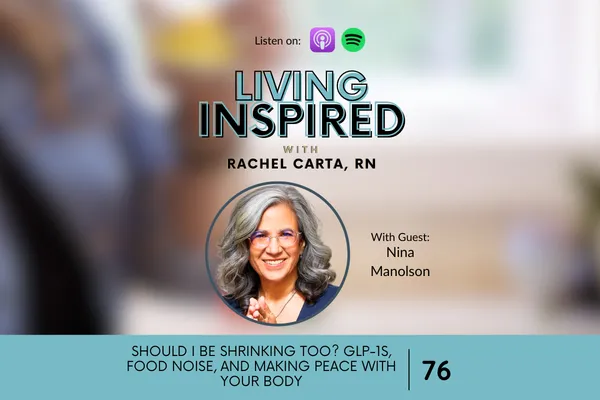
Should I Be Shrinking Too? GLP-1s, Food Noise, and Making Peace with Your Body
You can listen to this conversation with body peace coach Nina Manolson on the Living Inspired Podcast at the top of this page, or read the full article below.
Nina Manolson is a body peace coach who helps women end the war with food and their bodies so they can finally feel at home in the body they have right now.
Nina is known for her deeply feminist, anti-diet body peace approach. She also brings 30 years of experience as a therapist to this work, which means she understands the emotional and relational layers under food, body image, and shame.
As a functional nutrition counselor and nurse working with women in perimenopause and beyond, I knew I needed to bring her voice here. Right now, there is a very loud conversation happening about bodies, weight loss, and GLP-1 medications. There is a much quieter conversation happening about what all of this is doing to our hearts, our sense of worth, and our relationship with our bodies.
This post is about turning the volume back up on that quieter, deeper conversation.
Growing Up in a World Where “Thin Is a Virtue”
I grew up in the 80s and 90s when thin was absolutely “the thing.” Low-fat everything. Diet pills like Fen-Fen. Seventeen Magazine covers telling us how to flatten, tone, shrink, and fix ourselves.
When I shared that with Nina, she reminded me that this obsession is not new. It was happening when she grew up. It was happening when her mother grew up. It has been handed down through generations: this idea that our value, especially as women, is tied to the size of our body.
Think about how often someone’s weight is the first thing mentioned when they walk into a room. “Oh, you’ve lost weight!” is treated like the ultimate compliment, as if their smaller body is the most interesting and important thing about them. Shrinking becomes a virtue. Thinness becomes a kind of moral badge.
We did have a moment where body positivity and size inclusivity became louder. There was a shift toward “all bodies are good bodies.” But with the huge wave of GLP-1 medications, that conversation has grown quieter again. The more dominant question underneath so many conversations sounds like, “What are you doing to shrink your body? What are you taking? What’s your plan?”
And under that, a quieter, more vulnerable question often rises up:
Should I be shrinking too?
I feel that question personally. I work with women who are dealing with chronic symptoms, low energy, mood swings, digestive issues, and the whole swirl that comes with perimenopause and beyond. For a while, the focus in my world was on feeling better, having more energy, and reducing symptoms. Then I started hearing more and more, “My sister is on this,” “My brother started that shot,” “My aunt, my coworker, my best friend is taking it.” I watched people around me shrinking rapidly and caught myself thinking, “Wait… should I be shrinking too? Did I miss something?”
Body Autonomy: “It Is Your Body”
Before we went any deeper, Nina brought in something really important: body autonomy.
Body autonomy is the idea that it is your body, and you get to choose what you do with it. That includes whether you take a GLP-1 medication, whether you try a certain food plan, whether you follow a protocol, or whether you decide not to.
For decades, other people have tried to tell women what they should do with their bodies. The medical system has had its say. The diet industry has had its say. Now the anti-aging industry, the longevity industry, and even the “menopause industry” have joined the chorus, insisting that there is a right way to look, to age, and to eat.
Body autonomy invites you to turn down that external noise and ask a much more personal question: What do I want? What truly helps me feel well in my own skin?
Neither Nina nor I are here to say that GLP-1s are inherently bad or wrong. What we are asking is: What is the impact of living with the constant sense that your body is a project you need to fix? What happens when, underneath everything, the main question you are asking yourself is, “Should I be shrinking too?”
When Your Body Becomes a Project You Manage
One of the most powerful moments in this conversation was when Nina talked about what she calls “body management.”
Many of us have unconsciously learned that our body is a project. We approach it like a job: something to optimize, supervise, and continuously improve. If we are not actively shrinking, tightening, tracking, or “anti-aging,” we assume we are doing it wrong. When someone else is shrinking on a medication or following a strict plan, it can look like they are getting an A in “being in a body,” while we feel like we are failing.
That mindset leads us quickly into shame. The story becomes, “I am wrong. My size is wrong. My symptoms are wrong. The way I am in my body is wrong.” When that story settles in, we move into deep body shame. This is not just about discomfort. It is about feeling fundamentally flawed.
Nina pointed out that this is what really damages our relationship with our body: the belief that there is a right and wrong way to exist in a body, and that we are always on the wrong side of the line unless we are actively managing and shrinking.
Relationship vs. Management: Listening to What the Body Needs
This is where our conversation shifted from managing the body to being in relationship with it.
In my own life, I see this very clearly in my journey with chronic migraines. For years, my approach looked like a lot of “management”: tracking patterns, trying multiple medications, cycling through diets and protocols, constantly adjusting and tweaking to try to get it “right.” It was exhausting.
More recently, I have started doing something different. In the middle of the pain, I pause and ask my body:
“What do you need right now?”
One day, as I sat in a wave of migraine pain and actually listened, what came back was simple: “Go outside and put your feet in the grass. Slow down.” Those messages did not come from a protocol. They came from inside my body.
Nina pointed out that this is exactly what a relationship looks like. Real relationships are not constant happy endings and sunsets. They are made of turning toward each other, asking questions, listening, and responding. When we relate to our bodies this way, we move out of combat and into connection.
The Risk of Outsourcing Our Relationship to a Drug or a Diet
Nina works with women who are not on GLP-1s, women currently using them, and women who have cycled on and off them. Her concern is not the medication itself as much as what happens when we outsource our relationship with food and body to anything outside ourselves.
For some women, the medication brings huge relief. If there has never been a safe or steady relationship with food or body, something that finally quiets the chaos can feel life-changing. There is real value in that, and it deserves respect.
But even with those benefits, we still live in our bodies. We still need to eat. We still have signals and needs and emotions that move through us every day. When the entire relationship is outsourced to a drug, a diet, or a program, the underlying pattern often remains unhealed.
Nina has seen women who, on these drugs, barely eat, or slip into disordered eating or full eating disorders. She has also seen women who feel a sense of freedom. Both experiences exist. Her point is that we cannot hand over our relationship with our bodies and food to something outside of us and expect it to do all the work.
Even if you choose a medication, you still deserve a deliberate, compassionate relationship with yourself and with food.
“Food Noise” or Food Communication?
One of the big phrases that has come out in conversations about GLP-1s is “food noise.” Many people describe that constant chatter in their heads:
What am I going to eat next?
Did I eat too much?
Was that too many calories?
Should I have the cookie?
Why did I eat the cookie?
Is there food nearby?
When will my next meal be?
For many women, this takes up an enormous amount of mental space. It is draining. It interferes with focus, joy, and presence. So when a medication seems to quiet that noise, it feels like a miracle.
Nina has mixed feelings about the phrase “food noise.” She completely understands how disruptive that chatter is. She has lived it herself and knows how exhausting it can be. But she invites us to look underneath it.
Where is the noise coming from? For some women, it is the result of years of dieting and deprivation, of always being told “you shouldn’t,” “you can’t,” “you’re not allowed.” For others, it may be tied to growing up with food scarcity or having someone else control their food. If your lens has always been “I’m not allowed to eat certain things,” then of course your mind will fixate on them.
Nina compared turning off “food noise” without asking where it comes from to muting a toxic argument without ever healing the relationship. The tension is still there, just unspoken.
There is also another layer. When we say, “It’s so great, I’m not thinking about food anymore—I don’t feel hunger or cravings,” we may also be muting something very important: our body’s communication.
Nina shared a simple but powerful example. As the seasons changed and it got colder, she noticed that she wanted butter on everything: butter on sweet potatoes, butter on muffins, butter for cooking eggs. Instead of shaming herself, she got curious and asked, “What is up with the butter?”
She realized that all summer long she had been swimming outdoors in the sun, and suddenly she was in an indoor pool. Less sun meant less natural vitamin D. Butter is one of the foods that contains vitamin D. Her craving was a message: “Your vitamin D may be low. Please get some on board.”
Cravings often tell a story. They might reflect a nutritional need, an emotional need, lack of sleep, or nervous system overload. When we mute all the “noise,” we risk muting those messages as well.
This is why Nina suggests asking two simple questions when that mental chatter about food shows up:
“What is this food noise saying?”
“Where did it come from?”
And to approach those questions with curiosity instead of judgment.
I see this in my work all the time. For example, when someone is craving something very high in sugar and fat after a night of poor sleep, it is not a sign that they are weak or broken. It is the body seeking fast energy to compensate for exhaustion. The body is not being bad. It is being wise.
The Poem: “I Don’t Want to Die Hating My Body”
At one point, I shared a story from my work as a hospice nurse.
I had a patient in her eighties who was on hospice care. In hospice, the rule is simple: you eat what you want. There is no restriction. She looked at me and said, “For the first time in my life, I can eat what I want. I’m dying, but now I get to eat what I want.”
Such irony. She had lived an entire life under restriction and shame, and in the final stretch, the rules were suddenly gone.
That story came back to me when I saw a line on Nina’s website:
“I don’t want to die hating my body.”
Nina explained that several of her clients in their seventies and eighties had said those exact words, and a poem was born. She read it during our conversation, and with her permission, I’m including it here.
I Don’t Want To Die Hating My Body
Please, don’t let me lay on my deathbed
Reviewing my life with regret
Because I wasted it on hating my body
I don’t want to die wishing I was thinner
Wishing that I hadn’t eaten that chocolate croissant
I don’t want to leave this earth
Feeling like I needed to apologize for my belly
My thighs or my double chin
I don’t want to occupy any more mental real estate
On what tomorrow’s diet should be,
how to hide my rolls,
Or what someone else thinks of my shape
I don’t want my last breath to be a release from the captivity of body-shame.
I won’t do it.
It’s been too many years, decades, lifetimes
Of letting the pursuit of perfection
shroud my joy, kill my pleasure, extinguish my beauty
I won’t die hating my body.
Instead I’ll live…
Caring for this body
Not dominating her
Not depriving her
So that I’ve lived in a free body
I’ll live…
Talking respectfully to this body
Not bossing her
Not shaming her
So that I’ve imbued her with honor
Each day choosing this body
As she is
To live with and within
Until I die
And leave this sacred skin
with appreciation for being my home
~ Nina Manolson
Body-Peace® Coach
I had tears in my eyes as she finished. I have watched many people at the end of life. I have seen what happens when the body finally loses weight because it is shutting down. I have seen what really matters when all the noise fades away: the love, the connection, the memories, the sense of whether they were at home in themselves.
If we could nourish our bodies not just with food, but with life—with reverence, gratitude, and appreciation—how different might our experience of chronic symptoms, aging, and change be?
“Hello, Body”: Starting a New Conversation
If you are reading this and thinking, “Okay, I want a more peaceful relationship with my body, but I have no idea how to start,” you are not alone.
One of Nina’s clients once said to her, “I’ve been in an abusive relationship with my body for 30 years. I would never tolerate anyone else talking to me the way I talk to myself.” When they explored what body peace might feel like, this same client said, “I feel like I missed this day at school.”
The truth is, there was no “body peace day” at school. Many of us never saw a model of someone who spoke kindly to their body, who treated it as sacred, who listened to it with curiosity and respect. We learned to monitor, criticize, and fix, not to relate.
Nina’s starting point is beautifully simple. She invites you to literally place a hand over your heart, close your eyes, and say—gently—
“Hello, body.”
That might sound small, but it’s the same way we begin any healthy relationship. We acknowledge. We greet. We show interest.
Your body may respond with a feeling of relief, as if it has been waiting a long time for you to pay attention. It might also be angry or skeptical. You might feel grief. Whatever comes up belongs in the conversation.
From there, you can ask:
“How are you?”
“What are you feeling?”
“What do you need from me today?”
“How can I support you?”
You might pick up a journal and let your body respond through your pen. Nina has two free journals on her website designed to help you do exactly that—the Practicing Body Peace Journal and a mini journal called I Don’t Want to Die Hating My Body. They include poems and questions she would ask if you were sitting together in a session, to help you explore your own relationship with your body more deeply.
When You Do Need to Change What You Eat
In my work, there are times when we need to remove or limit certain foods to help the body heal. Maybe we are working on IBS, joint pain, mood swings, migraines, or something else that has a strong food connection. This can be a really tender place, especially if someone has a long history of dieting and restriction.
I shared an example from my own life. I’ve been experimenting with a low-histamine way of eating to see if it affects my migraines. My old inner voice would have sounded like, “You’re not allowed to eat that banana bread. It’s not on the plan. You can’t have that.”
This time, I caught myself and shifted to something different. I reminded myself that I can have it. I am an adult. I am allowed. Then I told myself the truth: “Right now, I’m choosing not to have it because I really want to understand whether these foods affect my migraines.”
That small shift—from “I can’t” to “I’m choosing”—completely changed how it felt.
Nina named this as an example of “full permission to eat,” a concept in intuitive eating. You are allowed to eat the thing. You are also allowed to care about how it makes you feel. Inside, you might notice a whole cast of inner characters: the rebel who doesn’t want anyone to tell her what to do, the deprived part who is tired of missing out, and the wise part who is genuinely curious about how your body will respond.
Instead of shutting down those parts with more rules, body peace invites you to listen to them, acknowledge what they feel, and then make a choice from the part of you that cares most about your long-term wellbeing.
Self-Compassion Makes Healthy Actions Easier
Nina also brought in research on self-compassion from Kristin Neff and Christopher Germer. Their work shows that when we meet ourselves with kindness instead of criticism, we are actually more likely to take good care of ourselves. When we come to ourselves with a harsh “you need to” energy—“you need to go to the gym, you need to stop eating that, you need to do better”—another part of us naturally rises up in rebellion and says, “No. You’re not the boss of me.”
When we come in with compassion—“I care about how you feel,” “I want you to have less pain,” “I’m here with you”—we are much more likely to make choices that truly support us. The same is true when we are adjusting food for healing. We can create structure without turning it into a punishment.
“I Just Want to Feel More Comfortable in My Body”
Many of the women I work with tell me they want to be smaller. But when we dig deeper, the desire is often about comfort, not worth. They are uncomfortable in their joints, in their clothes, in their day-to-day movements. They feel limited or restricted in what they can do physically.
Nina responds to that with a lot of compassion. It is real. It can be physically and emotionally uncomfortable to live in a body that feels heavy, painful, or awkward. We can be honest about that and still treat ourselves gently.
She talks about being “body current.” Being body current means living in the body you have today, not chasing the body you had at sixteen or pinning all your hope on a future version of yourself. Your current body might have headaches, joint pain, stretch marks, scars, or mobility limitations. It might not be the body you dreamed of. It is still the body that carries you through your life.
The question becomes, “How do I support this body today? How can I make life more livable, more vibrant, more spacious in the body I’m actually in?”
That is different from endlessly trying to earn the right to live your life by achieving a certain size.
Your Sacredness Lives in This House
At one point, Nina said something that really stayed with me:
“My sacredness, my soul, lives in this house.”
She was talking about the body as a home for our sacredness.
If we really believed that, how would we treat this home? We would not spend all our time hating the walls and wishing the floors were different. We would learn how to care for it, maintain it, and honor it.
I shared a story about my own body. I have a scar on my forehead that I used to dislike. One day, my ten-year-old son looked at me and said, “Mom, if you didn’t have that scar, your forehead would be boring.” I loved that. It reminded me that the things we see as flaws are often part of what makes us uniquely ourselves.
The same is true for lines, stretch marks, changes in hair, and all the shifts that come with living in a body over time. They are not proof that we are failing. They are evidence that we are alive.
When GLP-1 Content Triggers You
To bring it back to GLP-1s and the social media world we live in: we are all seeing constant before-and-after photos, “transformation” stories, and posts about shrinking. If you notice that this content spikes your anxiety, jealousy, or shame, that does not mean you are shallow or weak. It means something in you is being touched.
You can bring the same relational approach here. Put your hand on your heart and say, “I see you noticing that. I can feel that this is bringing something up for you.” Then, very gently, ask yourself, “What is this touching in me?”
Michael Singer, author of The Untethered Soul, talks about how life “touches our stuff.” GLP-1 content is touching our stuff. Maybe it brings up old messages about not being good enough, childhood comments about your body, fear of aging, fear of being left behind, or grief over how your body is changing.
Instead of shutting that down or judging yourself, you can stay curious. “What is this showing me about what still hurts? What needs more care and healing in me?” These moments can be invitations to turn back toward yourself, not reasons to abandon yourself.
Three Simple Truths to Tape to Your Mirror
At the end of our conversation, I asked Nina a few quick questions. Her answers felt like truths worth keeping close:
A belief she has let go of:
That her body should be different than it is.
An underrated body peace habit:
Touching your own body with kindness—hand on heart, a gentle hug, stroking your hair or face—as if you were the most sacred being walking the planet.
A line from her poetry she wishes every woman would tape to her mirror:
“Your body is your home.”
We spend so much energy trying to make our physical homes inviting and beautiful. This is the home we live in every moment of every day. It deserves at least as much care.
How to Go Deeper with Nina
If this conversation stirred something in you, you can find more of Nina’s work atninamanelson.comorbodypeacewithnina.com. On her site, you’ll find her free journals, a free masterclass, her Body Peace Deck, and the Body Peace Podcast.
All of these are designed to help you practice a gentler, more honest relationship with your body—one conversation, one breath, one small act of kindness at a time.
Final Note
If you are reading this and realizing that you have been at war with your body for a long time, I want you to hear this clearly: it does not have to stay this way.
Just as you would never advise someone you love to remain in a relationship that feels harsh, critical, or shaming, you do not have to stay in that kind of relationship with yourself. There is another way. A slower way. A kinder way. A way that makes room for curiosity instead of control, listening instead of managing, compassion instead of constant correction.
Your body is not a project to perfect. It is not a problem to solve. It is your home.
Your sacredness lives here.
Peace, calm, and confidence are not rewards you earn by shrinking, restricting, or doing it “right.” They are available through relationship. Through attention. Through learning how to turn toward yourself instead of away.
If this conversation stirred something in you, I invite you to listen to the full episode with Nina at the top of this page. Let her words land in your body, not just your mind. And if someone you love is quietly struggling with their body right now, please share this with them. These are conversations we were never taught how to have, but they are conversations that can change everything.
Thank you for being here, and thank you for being willing to listen to your body in a new way.
Lots of love,
Rachel
About Rachel Carta, RN
As a Registered Nurse, Author, Functional Nutrition Counselor, & Life Coach, I help women who are tired of feeling off—low energy, digestive issues, brain fog, mood swings, or just not feeling like yourself. You can wake up with energy. You can feel good again in your body. You can reconnect to the vibrant, grounded you. You don't have to do this alone. Book a free consultation here: RachelCartaRN.com/schedule.