Stop Starting Over: Why Learning to Resume Changes Everything
Custom HTML/CSS/JavaScript
You can listen to the full podcast episode using the embedded player above.
Have you ever told yourself, "I'll start again on Monday"?
Maybe you were finally getting into a good routine with your workouts, eating meals that made you feel good, or finding a little more time for yourself. Things were going well, and you were starting to feel that sense of accomplishment that comes from following through on something important to you. And then life happened. Someone got sick, work got busy, your schedule changed, or you simply had a few days when you didn't have the energy to keep up with everything. Before you know it, you're telling yourself that you've gotten completely off track and need to start all over again.
I know this pattern because I've experienced it myself, and I see it with my clients all the time. But there's something I've been reminding my clients for years that I think we all need to hear a little more often: You never go all the way backward. Everything you've learned, every healthy choice you've made, and every bit of progress you've experienced still counts, even when you've taken a break.
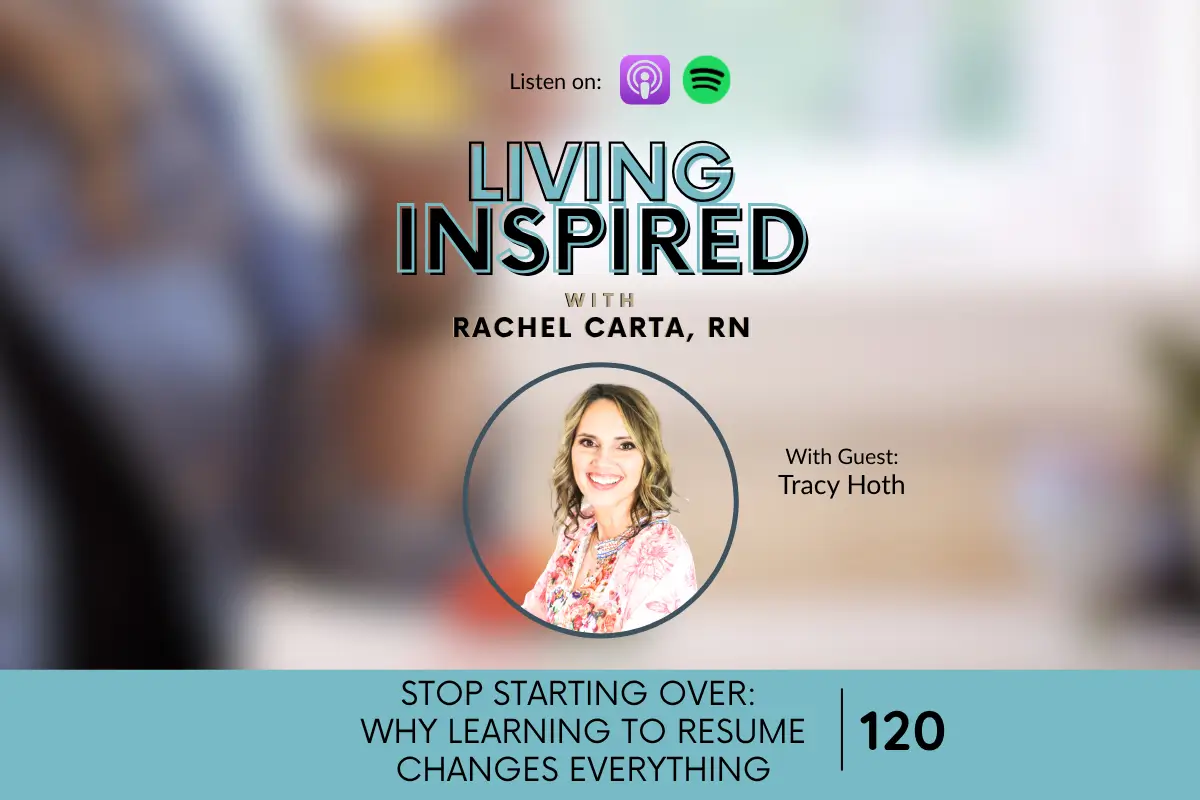
That's exactly what my friend Tracy Hoth and I talked about in Episode 120 of the Living Inspired Podcast. Tracy is a certified life and organizing coach and the host of the Organized Coach Podcast, which is ranked in the top 1% of podcasts globally. She helps women simplify their homes, lives, and businesses through practical systems and mindset shifts so they can spend more time focusing on what matters most.
While you might expect us to be talking about organizing closets or managing schedules, our conversation went much deeper. We explored something I see frequently in my work with women, and something I've experienced plenty of times myself: the tendency to believe we have to start all over again whenever life interrupts our progress. Tracy shared a simple shift in perspective that can change how we approach our health, our habits, and just about anything we're working toward. Instead of constantly restarting, what if we learned how to resume?
What If You Didn't Have to Start Over?
Think about the difference between the words restart and resume. When we tell ourselves we're restarting, we're essentially saying that we're going back to the beginning. We look at the time we've missed or the habits we've gotten away from, and suddenly it feels like everything we accomplished before that point no longer matters. But is that really true? If you were consistently working out for a month and then missed a week, did those workouts suddenly stop benefiting your body? Of course not. If you've spent time learning which foods help you feel your best, does that knowledge disappear because you've had a few days of eating differently? Absolutely not.
And yet so many of us approach our health, our routines, and even our personal growth as though one interruption erases everything that came before it. Tracy shared that she used to focus on becoming really good at restarting. But when she began thinking about resuming instead, it completely changed how she approached those inevitable interruptions.
She gave an example from her own life. Her daughter had recently gotten married, family was visiting, and her normal exercise routine was interrupted. Then she had another trip coming up. Instead of making that mean she'd fallen behind, she simply decided when she would pick up her workouts again. There was no guilt, no elaborate plan to get back on track, and no need to wait for another Monday. She just resumed, and I love this because it takes so much unnecessary pressure out of the equation.
Sometimes the Hardest Part Is What We Tell Ourselves
Something I've noticed in my own life and in my work with women is that the interruption itself often isn't what keeps us stuck. It's what we tell ourselves about the interruption. Think about a woman who's been working hard to improve her nutrition. She's been planning meals, eating more consistently, and noticing that her energy and digestion are improving. Then she has a particularly stressful week. She doesn't make it to the grocery store, she's grabbing whatever is easiest for dinner, and suddenly she's frustrated with herself.
Instead of recognizing that she had a busy week and needs to make time for grocery shopping again, she starts telling herself that she has no discipline or that she can never stick with anything. Now she's dealing with more than a disrupted routine. She's also carrying around the frustration and disappointment she's created around it.
This is where I think understanding our nervous system becomes so important. When we're already stressed, exhausted, or overwhelmed, criticizing ourselves for everything we're not accomplishing often makes it even harder to take the next step. I've worked with so many women in midlife who are already juggling careers, families, relationships, changing hormones, and bodies that don't always respond the way they used to. The last thing they need is another reason to feel like they're falling short.
What they often need is permission to adjust their expectations, recognize what they've already accomplished, and figure out what makes sense for them right now. Because the goal isn't to create a perfect routine that only works when life is going smoothly. It's to create habits that can support you through the different seasons of your life.
What If You Looked at It as Practice?
One of my favorite moments from my conversation with Tracy was when she shared something a client had realized. For a long time, this woman believed she kept falling short because she wasn't consistently following through on the things she wanted to accomplish. But eventually, she recognized that she hadn't been falling short. She'd been practicing.
I love that perspective, and it immediately reminded me of a book I've recently been reading called Practicing the Way, which explores what it means to practice following Jesus. So much of life really is practice, and I think we tend to forget that when we're focused on achieving a particular outcome or reaching a specific goal.
Think about yoga. I've been practicing yoga for years, and one of the things I appreciate most about it is that we call it a practice for a reason. Some days you feel strong, balanced, and completely connected to your body. Other days, your balance is off, you're distracted, or a pose that usually feels comfortable suddenly feels difficult. You don't throw away everything you've learned because you had one challenging class. You come back to your mat and continue practicing.
What if we approached our nutrition, movement, relationships, and personal growth the same way? Instead of expecting ourselves to get everything right, we could focus on learning what works, making adjustments when something doesn't, and continuing to show up. And the more we practice, the more we begin to understand ourselves.
Are You Spending More Time Planning Than Doing?
This part of our conversation really resonated with me because I can absolutely see myself in it. Sometimes we convince ourselves that we need a better plan before we can move forward. We need a new planner, a more organized calendar, a detailed workout schedule, or the perfect meal plan. And don't get me wrong, I love a good plan. I think planning can be incredibly helpful, especially when you're managing a busy household, running a business, or trying to make your health a priority. But there's a difference between planning something that helps you take action and using planning as a way to avoid taking action.
Tracy talked about how planning can sometimes feel safer than actually doing the thing. When we're planning, we don't have to face the possibility that something won't go the way we expected. We haven't made a mistake, nobody has seen us struggle, and we can keep imagining how perfectly everything will work once we begin. But eventually, we have to give ourselves the opportunity to practice.
Tracy suggested something I think is incredibly helpful. Instead of trying to plan an entire month or completely overhaul your routine, just decide what you're going to do tomorrow. When will you move your body? What are you going to make for dinner? When can you take a few minutes to yourself? Start there, then pay attention to what worked and what didn't, and use that information to make your next decision. I think we underestimate how much we can accomplish when we stop trying to figure everything out before we begin.
The Road Trip That Changed How I Think About Big Goals
Tracy shared a story about taking a road trip with her family that really illustrates this idea. They were driving to Texas with their children when they had car trouble shortly after leaving home. They had to find a repair shop, wait for the van to be fixed, and then continue their trip. But imagine if they'd decided that because the trip hadn't gone according to plan, they needed to turn around, drive home, unpack everything, and start again the next day. That would seem ridiculous, wouldn't it? And yet, that's exactly what we do with so many of our goals.
Her story reminded me of something I experienced years ago when Hunter was little. He was about two years old, and I needed to drive from North Carolina back home to Massachusetts. It was roughly a fifteen-hour drive, and I was doing it alone with a toddler. Just thinking about the entire drive felt overwhelming, so I decided I wasn't going to focus on the fifteen hours. Instead, I told myself I'd drive a couple hundred miles and see how we were doing.
When we got to that point, I checked in with myself. Hunter was doing okay, I was doing okay, and we could keep going. Eventually, we made it to New York City, and I realized we only had about four hours left. And you know what? We made it all the way home. Had I spent the entire morning thinking about how I was going to survive fifteen hours in the car with a two-year-old, I probably would have talked myself out of even trying. But by focusing on the next manageable stretch, I was able to do something that initially felt impossible.
I think about this with my clients all the time. When you're dealing with digestive issues, exhaustion, hormonal changes, or trying to make meaningful changes to your health, it's easy to become overwhelmed by everything you think you need to do. You start thinking about all the meals you need to change, all the workouts you should be doing, all the supplements you might need, and how long it's going to take before you start feeling better. But what if you didn't need to figure all of that out today?
What if you focused on the next step? Maybe it's eating a balanced breakfast, going for a walk after dinner, or getting to bed a little earlier. Those things may seem small compared to the bigger goal, but they're how we begin moving in the direction we want to go. And when something interrupts that progress, we don't need to turn around and head back to the beginning. We simply continue from where we are.
Your Routine Needs to Work for the Life You're Actually Living
This is something I've had to practice quite a bit in my own life recently. Hunter is on the swim team, and his practice schedule has changed the rhythm of our evenings. We're at swim practice four nights a week, and we have church another evening. I'll admit, I resisted having such a busy schedule at first. But what I've realized is that I can either spend my time wishing our evenings looked different, or I can figure out how to make our current schedule work for our family.
So I've been using my Crockpot a lot more because I know dinner needs to be ready when we get home. Some meals have been great, and others definitely need some work! I've also started using Hunter's swim practice time for my own workouts. I typically prefer exercising earlier in the day, and by evening I'm often tired. But that's the time I have available right now, so I'm making it work.
Then, just when I was getting into that routine, there was an issue with the pool, and practice moved to another facility that didn't have the weight equipment I normally use. I could have decided that I couldn't work out because the situation wasn't ideal. Instead, I went for a walk. And that's something I really want women to understand: Something is still better than nothing, and your routine doesn't have to look the same every day to be worthwhile.
We can think of our routines like an accordion. There are days when we have more time, energy, and flexibility, and we can expand what we're doing. Other days, life requires us to make things smaller. Maybe you normally have an hour to exercise, but today you only have fifteen minutes. Maybe you planned to cook a beautiful dinner, but you've had an exhausting day and need something simple. Maybe you were hoping to spend thirty minutes meditating or practicing yoga, but all you have is five minutes to sit quietly and breathe.
Those smaller efforts still matter. I think sometimes we're so focused on what we believe we should be doing that we overlook all the opportunities we have to take care of ourselves in smaller ways. And those smaller actions can make it much easier to maintain some consistency, even when our circumstances change.
Small Actions Really Do Add Up
Tracy shared a story about a client who had been overwhelmed by the amount of paperwork in her home. The task felt so big that she struggled to even begin. Instead of focusing on organizing the entire house, Tracy encouraged her to start with just five pieces of paper a day. Five pieces. And over time, that woman worked through all of the paperwork.
I love stories like this because they remind us that progress doesn't always require some enormous effort. Sometimes it requires a willingness to start small enough that we can actually follow through. It's one of the reasons I've been working on my own yoga practice in smaller increments rather than expecting myself to commit to some huge daily routine.
I don't need to promise myself that I'm going to practice yoga every single day for the rest of my life. I can decide to practice for twenty minutes today, and tomorrow I can make another decision based on what my day looks like. I know that might sound almost too simple, especially if you're someone who is used to setting big goals and pushing yourself to accomplish them. But I've learned that simple doesn't mean ineffective. In fact, sometimes simplifying what we're asking of ourselves is exactly what allows us to move forward.
The Fresh Start Effect and Why We Don't Have to Wait for It
There's actually a psychological concept called the fresh start effect, which helps explain why certain dates feel especially motivating. Think about how you feel at the beginning of a new year, on your birthday, or even on a Monday morning. There's something about having a new beginning that makes us feel excited about the changes we want to make. And I don't think there's anything wrong with using that motivation.
I recently had a birthday myself, and I understand how meaningful those moments can feel when you're thinking about what you want the next season of your life to look like. But here's where I think we can get ourselves into trouble. When we rely on a fresh start to make changes, we can begin believing that we need another fresh start every time something doesn't go according to plan.
We miss a few workouts, and suddenly we're waiting for Monday. We eat differently than we'd planned over the weekend, and now we're waiting until the first of the month. We have a stressful season at work, and we decide we'll take care of ourselves when things settle down. But life doesn't always settle down when we expect it to, and if we're continually waiting for the perfect moment to begin again, we can spend a lot of time waiting.
That's why I love the idea Tracy and I discussed of pairing the fresh start effect with what we called the resume effect. Use those moments of motivation when they come. Enjoy the feeling of a new beginning. But when life interrupts your progress, remember that you don't have to wait for another one. You can simply resume.
So Where Do You Go From Here?
As you think about your own life, I want you to consider where you might be telling yourself that you need to start all over again. Maybe it's your nutrition, exercise, sleep routine, or something completely unrelated to your health. Maybe you've been waiting until your schedule gets easier or until you have enough time to do things exactly the way you want. What would happen if you stopped thinking about everything you need to accomplish and simply focused on what you could do next? And what if you gave yourself a little more grace when things didn't go according to plan?
Because those healthy meals you prepared last month still count. The workouts you completed still count. The things you've learned about yourself and the ways you've grown don't disappear just because you've had a difficult week.
You're going to have interruptions. You're going to have days when you don't follow through on everything you intended to do. And there will be seasons when the routines that once worked beautifully for you simply don't fit your life anymore. That's part of being human. The important thing is learning how to adjust, recognize the progress you've already made, and keep moving forward in a way that works for you.
You don't need to start all over again. You just need to pick up where you left off.
If this is something you've struggled with, I think you'll really enjoy my conversation with Tracy on Episode 120 of the Living Inspired Podcast. We talk more about why we get stuck in these patterns, how to approach our goals differently, and practical ways to make progress without putting so much pressure on ourselves. I hope you'll give it a listen.
Lots of love,
Rachel
Connect with Tracy:
Site: https://simplysquaredaway.com
Rachel's Free Resources:
Mood Swings? Get the 5 minute audio to calm them now. https://rachelcartarn.com/sos
Do you want to understand more of what's changing in your body in midlife and get a few simple tools to feel better now? Get the free guide: The Real Reason You Still Feel Off.
Ready to Talk: Book a Clarity & Relief Session here.