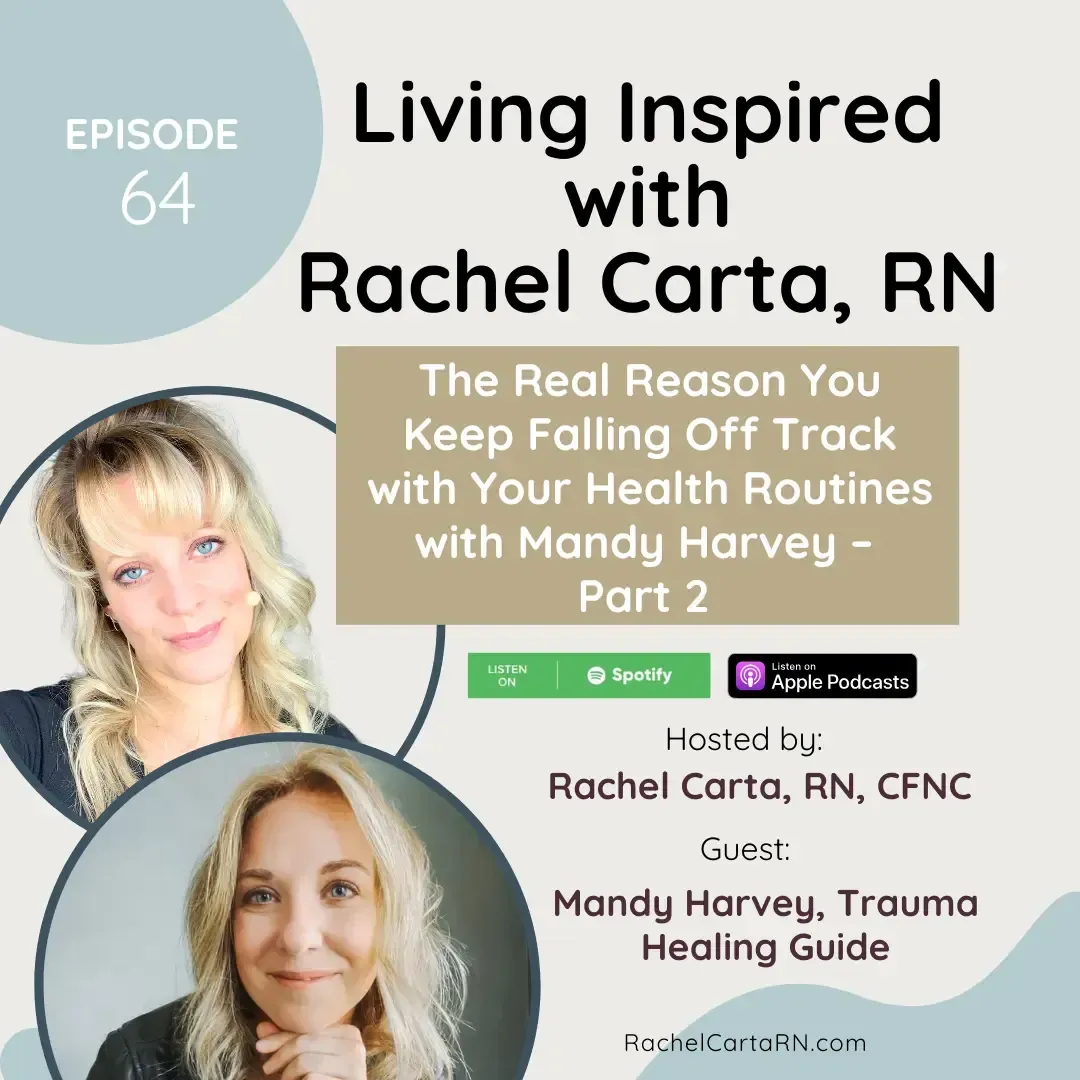
The Real Reason You Keep Falling Off Track with Your Health Routines with Mandy Harvey – Part 2
Part 2 of my conversation with trauma healing guide Mandy Harvey
In Part 1 of this conversation, Mandy Harvey shared her powerful story of healing from trauma, and we explored how emotional wounds can keep us stuck in cycles of stress, self-blame, and starting and stopping on our health journey. We also unpacked how the nervous system responds to stress — and how chronic dysregulation can show up in everything from bloating to burnout.
Today, we’re going even deeper.
We’ll explore how beliefs like “I’m not good enough” live in our body, why motivation isn’t the answer, and how to build a relationship with your body that opens the door to lasting healing. Plus, Mandy shares a somatic practice you can start using right away.
Let’s pick up where we left off…
Why Motivation Isn’t the Answer (and What Is)
If you’ve ever felt like you should be doing the healthy thing — going for the walk, prepping the meal, taking the time for rest — but you can’t seem to follow through…
It’s not because you’re lazy or unmotivated. It’s because part of you doesn’t feel safe enough to move forward.
As Mandy shared:
“You might have a conscious belief that you can heal… but if there’s an unconscious belief that it’s not safe, or that you’re not worthy of healing, that will always override your actions.”
This mismatch is what leads to inconsistency, burnout, and “self-sabotage” — which Mandy redefines as an unconscious protective pattern, not a conscious choice to ruin your progress.
Beliefs Are More Than Thoughts — They’re Energy in the Body
Here’s where things get powerful: those beliefs we carry? They’re not just in your mind. They live in your body. Mandy explains that beliefs like“I’m not enough,” “Nothing works for me,”or“It’s not safe to be healthy”can feel like an invisible cloak you wear.
And when your body is holding onto that energy, it doesn’t have space for healing.
“We can try to change our health all we want — but if we’re carrying the belief that we’re broken, that belief will dictate our outcome.”
This hit home for me in a deeply personal way. I shared a story from my childhood — how my gym teacher humiliated me in kindergarten by calling me unathletic in front of the class. Even though I went on to become a personal trainer, that voice stuck with me. I still hear it when I try to start a movement routine.
Mandy gently reminded me:
“That voice isn’t even yours. It was never your belief to begin with. And you get to choose whether you keep it or not.”
What belief are you still carrying that was never yours to begin with?
Create Space Between the Thought and the Action
Mandy and I both talk about creating space. When we pause and notice what’s really going on inside — whether it’s a story, a memory, or an emotional reaction — we reclaim our power to choose a new response.
Instead of automatically falling into the pattern (“I always quit,” “I never stick with it”), you can gently ask:
What belief is showing up here?
Is it even mine?
What might be possible if I let it go?
The Body Talk Practice: A Kind, Curiosity-Led Way to Reconnect
This is where Mandy’s work is so transformative. She teaches something she calls Body Talk, which invites us to meet our resistance with compassion instead of judgment.
It’s not about pushing through. It’s about tuning in.
Here’s how it works:
Notice what’s showing up (frustration, anxiety, resistance)
Pause and ask where it lives in your body (chest? throat? stomach?)
Get curious:
What color is it?
What shape is it?
How old does it feel?
What does it need?
What does it want to say?
Offer kindness. Imagine holding that part of you the way you would a scared child.
“So many of us have an unloving relationship with our bodies,” Mandy said. “But your body is doing the best it can. It’s been trying to protect you all along.”
This gentle practice creates space — not only in your thoughts, but in your cells. Over time, this is what helps release stored emotions and allows healing to begin.
What “Self-Sabotage” Really Means
If you find yourself doing well and then suddenly crashing — skipping workouts, eating foods that don’t feel good, avoiding your self-care — it doesn’t mean you’re weak.
It likely means your system is scared.
One example Mandy shared was from a CDC/Kaiser study where many participants who struggled to lose weight had experienced childhood trauma. One woman explained that when she started to lose weight, she suddenly felt unsafe — because thinner felt more vulnerable. Without even realizing it, she started to pull back.
This is what the body does when it’s protecting you.
The goal isn’t to shame or fix it. The goal is to understand it.
So What Can You Do?
Here’s what Mandy recommends if you're feeling stuck or frustrated:
Pause. Don’t push through the overwhelm.
Feel what’s there. Notice it in your body without trying to fix it.
Let it speak. Use Body Talk to learn what that emotion or belief is trying to say.
Create space. Even 90 seconds of simply being with the emotion allows it to pass.
Breathe in the new belief. Exhale the one that was never yours to begin with.
Mandy also shared a breathwork practice I love:
“Breathe in the version of you that is strong, capable, and worthy.
Breathe out anything that isn’t yours to carry anymore.”
You Were Made to Heal
You are not stuck. Your body was created to heal — and your nervous system can be rewired with patience, compassion, and support.
Whether you’re working on your health, your habits, your relationships, or your sense of worth… there’s hope. There’s a way forward. And it starts with listening to what your body has been trying to tell you all along.
You don’t have to push harder. You don’t have to earn your healing.
You get to come home to yourself — gently, one breath at a time.
Gentle Journal Prompt:
Where do I feel most stuck right now?
What might that part of me be trying to say?
Whose belief is it, really?
You deserve to feel at home in your body. You deserve to feel steady, supported, and safe enough to take the next step—without shame, pressure, or perfection. Healing isn’t about doing more. It’s about getting quiet enough to hear what your body’s been trying to say all along. If something in this conversation spoke to you, I hope you’ll give yourself permission to pause, breathe, and listen. You're not broken. You're responding exactly as you were wired to survive. And the beautiful news? That wiring can be rewritten—one small, compassionate step at a time.
If this resonated with you, we’d love to hear from you. Come find Mandy @mandylharvey and me @rachelcartarn on Instagram, and let us know what landed for you. Or share this blog with a friend who’s been feeling stuck—you never know how much they might need to hear this, too.
Lots of love,
Rachel
About Rachel Carta, RN
As a Functional Nutrition Counselor & Life Coach, I help women who are tired of feeling off, have low energy, digestive issues, brain fog, and/or mood swings. You can wake up with energy. You can feel good again in your body. You can reconnect to the vibrant, grounded you. You don't have to do this alone.
About Mandy Harvey
Mandy Harvey is a leader in the field of trauma healing as well as an in-demand inspirational speaker. She specializes as a Trauma Healing Guide for nutrition and health coaches, helping them become the go to coach who can guide any client through their blocks and create lasting change. Her super power is showing coaches how to bridge the gap between their nutrition education and their clients’ resistance to change and empowers them with vital trauma-informed expertise and somatic skills to help them successfully lead their clients through life-altering transformations.
Free gift: StopYourBrainBully.com— a free mini-series to help you quiet the inner critic