
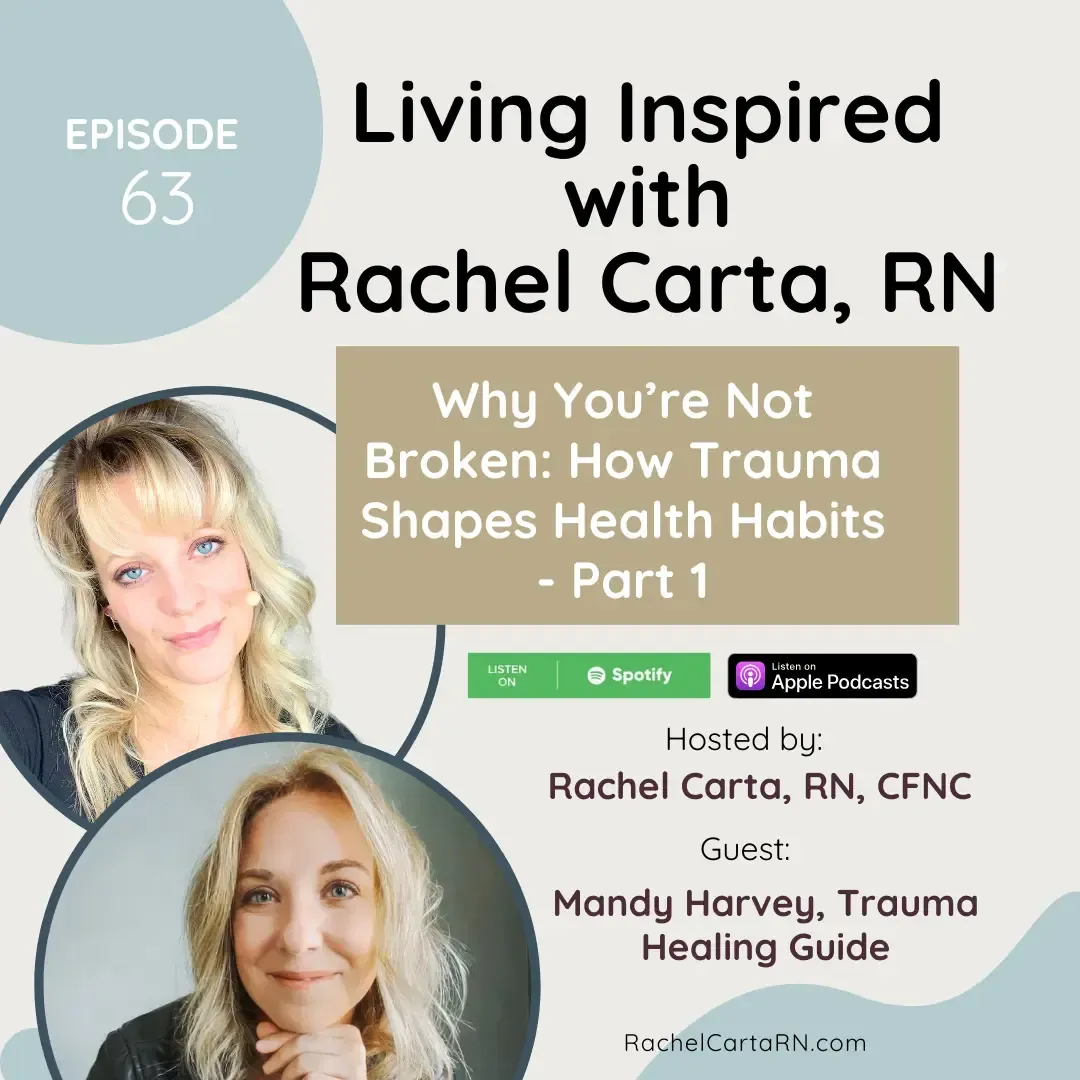
Why You’re Not Broken: How Trauma Shapes Health Habits (with Mandy Harvey) - Part 1
Have you ever wondered why you keep getting stuck, even though you want to feel better? You know what to do. You’ve tried all the plans. And still, you find yourself starting and stopping, again and again. If you’re nodding your head, this post is for you.
In this two-part series, I sat down with trauma healing guide Mandy Harvey for one of the most heartfelt and enlightening conversations I’ve had on the podcast. Mandy shares her powerful personal story and helps us understand why resistance is not failure—it’s communication. What if your struggle to follow through isn’t about willpower at all? What if it’s your body trying to keep you safe?
Let’s explore what’s really going on beneath the surface.
You’re Not a Failure. You’re Responding to Something Real.
One of the most common things I see in the women I work with is this cycle: we want to change, we start strong, we get stuck, we stop. And then? We blame ourselves.
But what if resistance isn’t something to fight? What if it’s a signal from your body?
My guest, Mandy Harvey, understands this deeply. She’s a trauma healing guide who helps people uncover why change is hard—especially for those with a history of trauma, chronic stress, or perfectionism. In this post, you'll meet Mandy, hear her powerful story, and begin to see resistance and stuckness in a whole new light.
Mandy’s Story: From Trauma to Transformation
Mandy didn’t begin her work in trauma healing by chance. It began with her own health transformation and a background in functional nutrition. But beneath her physical health challenges were deeper emotional wounds rooted in early trauma.
As a child, Mandy experienced ongoing abuse, and at age 14, after bravely speaking up, she lost both of her parents to suicide. That moment, and the years of guilt that followed, left an imprint that shaped how she saw herself. She internalized a belief that it was all her fault—that she couldn't trust herself.
This led to a lifetime of perfectionism, chronic stress, and outsourcing her decisions to others. She appeared successful on the outside, but internally, her nervous system was in overdrive, and her health began to crumble. A diabetes diagnosis after the birth of her second child brought her to a breaking point.
One night, crawling to the kitchen from a dangerously low blood sugar crash, Mandy had a moment of clarity: "I can't live like this anymore."
She began to change her diet and movement habits. She started feeling better. But when she began working with clients, she noticed something curious: even when people started to feel better, they often reverted to old patterns.
Why?
The Missing Piece: It’s Not Just About Strategy
Mandy realized that even with the best nutrition plans or health strategies, people would fall back into the cycle of stuckness. The real root of their struggle wasn’t about food or discipline. It was about beliefs and the emotional energy stored in the body.
Many of Mandy's clients had experienced some form of trauma. Whether it was abuse, neglect, perfectionism, or never feeling seen or heard, they carried beliefs like:
"I'm not enough."
"Nothing ever works for me."
"I'm broken."
These beliefs become lenses through which we view our bodies and our efforts to heal.
And even when people want to get better, if the underlying belief is "this won't work for me," they unconsciously block their own progress.
Beliefs Are Stored in the Body
As Mandy explained, healing isn’t just about changing behavior. It's about understanding that the emotional wounds we carry from childhood are stored in our nervous system.
The inner child who was abandoned, blamed, or ignored is still living in the body. And unless we consciously tend to that part of ourselves, it continues to shape how we respond to stress, change, and even success.
It shows up in perfectionism, emotional eating, anxiety, control patterns, or collapsing when something doesn't go as planned. It's not sabotage—it's protection.
Trauma and the Nervous System: What’s Really Happening
So how does trauma affect our physiology?
We all have an autonomic nervous system that helps us respond to stress. It's made up of two branches:
Sympathetic Nervous System (fight, flight, freeze): This activates during stress. Your heart rate goes up. Blood rushes to your muscles. Digestion slows down. You're ready to run.
Parasympathetic Nervous System (rest and digest): This helps you calm down, connect, and recover.
Ideally, we move between these two states like a wave: stress rises, we respond, and we come back down.
But when you experience trauma—especially as a child—you often don’t have the ability to fight or flee. That energy gets stuck in the body. And if stress becomes chronic, your nervous system gets stuck in overdrive. You stop swinging back to calm.
Over time, this wears down your immune system, your hormones, your digestion, and your emotional resilience.
Why This Matters for Your Health Today
If you’ve ever felt like you’re always on edge, overwhelmed, bloated, tired, or emotionally reactive, it might not just be a mindset issue. It might be a nervous system issue.
And here’s the hopeful news:
Your body is designed to heal. Your nervous system can be regulated again.
Even small steps can create massive change.
In fact, I always share with my clients that one of the most powerful tools for healing digestion is simply taking three deep breaths before a meal.
Why? Because you're signaling to your body that it's safe to rest and digest. And in a world where most of us rush through our meals, this one shift can reduce bloating, improve digestion, and begin to restore balance.
Coming Up in Part 2:
Next week, we’ll dive deeper into the emotional beliefs that hold us back, the body-based practices that help us release stuck energy, and Mandy’s beautiful method called "body talk" that helps you listen to the wisdom inside.
We’ll also talk about what it really means to create safety in the body—and how to stop blaming yourself for not being consistent.
You are not broken. You are responding exactly the way your system was trained to.
And healing is possible.
Stay tuned for Part 2: How to Rewire Your Body’s Stress Response and Heal from the Inside Out.
Lots of love,
Rachel
About Rachel Carta, RN
As a Functional Nutrition Counselor & Life Coach, I help women who are tired of feeling off, have low energy, digestive issues, brain fog, and/or mood swings. You can wake up with energy. You can feel good again in your body. You can reconnect to the vibrant, grounded you. You don't have to do this alone.
About Mandy Harvey
Mandy Harvey is a leader in the field of trauma healing as well as an in-demand inspirational speaker. She specializes as a Trauma Healing Guide for nutrition and health coaches, helping them become the go to coach who can guide any client through their blocks and create lasting change. Her super power is showing coaches how to bridge the gap between their nutrition education and their clients’ resistance to change and empowers them with vital trauma-informed expertise and somatic skills to help them successfully lead their clients through life-altering transformations.