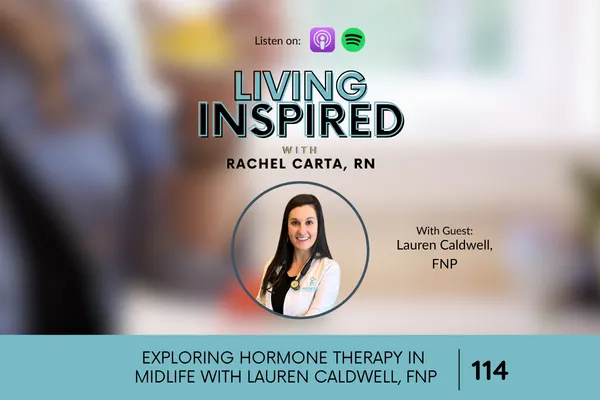
Exploring Hormone Therapy in Midlife With Lauren Caldwell, FNP
Custom HTML/CSS/JavaScript
You can listen to the full podcast episode using the embedded player above.
Something in my body has changed. My sleep is different. My mood is different. My energy is different too. Many of the women I work with describe the same shifts, along with anxiety, feeling flat, or being tired in a way that doesn't lift.
Sometimes we take all of that to the doctor, have labs drawn, and hear the famous words: "Everything is normal." And then the questions about hormone therapy start piling up. Who is a good candidate? Should labs decide the dose? What are the risks, and what are the benefits? How do you sort through so much conflicting information?
That's why I invited Lauren Caldwell onto Episode 114 of the Living Inspired podcast. Lauren is a board-certified family nurse practitioner and the founder of Meridian Health and Wellness in Woodstock, Georgia. She specializes in bioidentical hormone replacement therapy and personalized hormone care, and what I appreciate most is how much of her work starts with listening.
Here's what we talked about.
The Symptoms That Bring Women In
Lauren said symptoms look different for every patient, but there's a common thread in what brings women to her office:
"For my females, it's really gonna be the hot flashes, the low libido, the poor sleep quality, just lack in motivation, brain fog."
Later in our conversation she added one more: weight that won't budge, even when a woman is doing exactly what used to work.
She also sees plenty of women who have already been told this is simply part of getting older. Her response to that:
"While the actual aging process is, normal, the symptoms that can impact our day-to-day lives so significantly, we don't have to suffer through those."
I also want to add some balance here. Not every symptom in midlife comes from perimenopause or menopause. There are over 100 potential symptoms linked to hormone imbalance, and that number alone tells you why we have to be discerning. What does this particular woman need? That question matters more than any list.
Why So Many of Us Were Told to Stay Away From Hormones
If hormone therapy makes you nervous, there's a history behind that. Much of the fear traces back to the Women's Health Initiative, a large study that began in the 1990s. The arm testing a combination of conjugated equine estrogens and a synthetic progestin was stopped early in 2002 because the health risks, including breast cancer and cardiovascular disease, outweighed the benefits.
Lauren's point is that the findings got applied to every kind of hormone:
"What happened unfortunately is everyone kind of lumped all hormones into one bucket, bioidentical hormones and synthetic hormones. And that's really where the fear started."
She told me her own doctor once advised her to stay as far away from hormones as she could, for as long as she could. I heard the same thing.
The conversation has shifted since then. In November 2025, the FDA announced it would remove the broad "black box" warnings from menopausal hormone therapy products, and in February 2026 it approved labeling changes for six products to remove references to cardiovascular disease, breast cancer, and probable dementia risk. More research on bioidentical hormones is coming out too, and I'd love to talk through some of those studies in a future episode.
Bioidentical and Synthetic: What's the Difference?
BHRT stands for bioidentical hormone replacement therapy. Lauren explained it this way: bioidentical hormones have the same chemical structure as the hormones your body makes or used to make. Synthetic hormones, often called traditional hormone replacement therapy, are structured differently.
Lauren is clear about where she stands. In her clinic, she won't prescribe a fully synthetic hormone, because in her view the side effects and risks aren't worth it when a bioidentical option exists.
I always tell my clients to make sure they're asking about bioidentical hormones when they talk with a prescriber. When I was prescribed progesterone, I called the pharmacy to confirm it was bioidentical. They gave me the manufacturer's name and told me to Google it. I share that because it's a good picture of how much we sometimes have to advocate for ourselves to get a clear answer.
Labs Are One Piece of the Puzzle
This is one of the biggest frustrations I hear about. I look at labs from a functional perspective, and I wanted to know how Lauren uses them in hormone care.
"I like to say labs are a piece of that puzzle... I'm not the type of provider that is solely gonna chase labs."
Labs give her a baseline and show what the body is or isn't producing, so she can see where the gaps are. But symptoms and medical history carry a lot of weight in her decisions too. In perimenopause especially, she looks at ratios between hormones instead of reading any single number on its own.
That made a lot of sense to me, because hormones in perimenopause can swing widely. Your estrogen could be in the 500s one day and far lower another day, and Lauren added that it can shift at different times of the same day. With estrogen receptors throughout the body, including the brain, of course you feel those swings.
What you're feeling is real, and it's biological. It's also happening while life keeps moving. Many women in perimenopause are raising young kids or teenagers (middle school and high school in my house), caring for aging parents, and working. That's a lot pressing on a system that's already fluctuating. The symptoms you notice come from your hormones, and also from your lived experience, your history, and everything else your body is carrying.
Progesterone, Sleep, and Mood
Progesterone tends to decline a bit more gradually than estrogen, and it can have a big effect on sleep and mood. Lauren said those are the two main areas she targets with it.
She also addressed something I'd seen her post about: some prescribers won't offer progesterone to women who've had a hysterectomy. Lauren disagrees.
"Even though you may not have a uterus, you still have breast tissue, you still have eye tissue, you still have brain tissue, that progesterone is gonna help to protect as well."
When I asked about oral micronized progesterone versus progesterone cream, she said she prefers the oral capsule, especially for women with poor sleep, because in her experience that's the form that acts on the brain's GABA receptors and helps with sleep and mood. She sees a role for creams in some cases, but for a woman who still has her uterus, she uses the oral capsule to make sure the uterine lining is protected.
Lauren kept coming back to one thing, and I want to repeat it: every patient is individual. What works well for one woman may not be right for another, whether we're talking about progesterone or different forms of estrogen.
Testosterone Is for Women Too
Testosterone for women is getting more attention, and there's still a lot of confusion about it. Lauren put it simply:
"Females need testosterone just as much as males need estradiol. We just need it in much different ratios."
We lose testosterone much the way we lose our other hormones. The symptoms she associates with low testosterone include low libido, trouble maintaining muscle, some mood changes, brain fog, and low motivation.
Two practical points came up here:
Look at free testosterone as well as total. Proteins in the blood bind to testosterone and make some of it unavailable. Lauren checks both total and free testosterone, because free testosterone is the amount your body can use.
The dose for women is much lower. A client recently asked me whether testosterone would give her big muscles and a deep voice. Those can be side effects, but the dose for women is much, much lower, and women can respond well when it's right for them.
Lauren favors testosterone cream for many of her patients. It isn't the only option, but creams and troches make it easier to adjust the dose over time.
Weight Changes and Brain Fog
These are two of the biggest concerns I hear in midlife. Lauren hears them too, often as "I'm doing the same exact thing I did 10, 15, 20 years ago, and now I'm gaining weight."
She explained that when hormones drop, body composition changes, and methods that once worked stop working the way they did. Her goal with hormone therapy is to help restore body composition so those efforts can work again. She's also honest about its limits:
"Hormone replacement is not the magic bullet. We can't replace our hormones, sit on a couch every night, eat a cake, and expect to lose weight."
Where she sees women get results is when hormone therapy is paired with good food and exercise.
On brain fog, she described hormone receptors in the brain becoming less active when hormones are low, and hormone therapy as a way to help wake them back up.
The body composition piece matters to me. I was a personal trainer for a long time, and I'm so glad the advice has changed. We've moved away from lifting two- and three-pound weights a hundred times toward lifting heavy enough to build muscle, which also helps build strong bones. That still needs to fit you. What injuries do you have? What feels good? Find someone who can teach you to do the exercises correctly, instead of grabbing a heavy kettlebell because a video told you to.
Hormones Work Best When the Foundations Are There
I wanted Lauren on the show because hormones are one tool, and they tend to work best when the rest of the body is in a good place to receive them.
In my own work, I've seen hormone therapy land like a firestorm in a body where blood sugar is unstable or other chronic conditions are going on. Lauren agreed:
"If our blood glucose is through the roof and we're seeing those significant shifts, a patient is gonna feel terrible even though their hormones may be fully optimized."
Many other conditions can look like a hormone imbalance, and everything has to work together. This is the work I do with women: looking at the whole story so hormones have a fighting chance of doing their job. If you're in perimenopause, your body is still producing hormones, and we want to create the conditions inside that support it. When a woman is chronically stressed and running on empty, sometimes we start with a few small things just to get her to a steady baseline first.
What About After Menopause?
One of my clients asked me to bring this question to Lauren: if you're already past menopause, is there any benefit to starting hormone therapy?
Lauren said yes, and she separates the benefits into two categories. The first is symptom relief. Hot flashes and brain fog may ease after menopause, but if symptoms are still there, hormone therapy can help. The second is prevention. As we age, bone thinning and heart disease become bigger concerns, and in her practice she uses hormone optimization with long-term health in mind as well as symptom relief.
Questions to Bring to Your Next Appointment
If this conversation stirred up questions about your own care, here are a few that came straight out of our discussion:
Could my symptoms be related to hormones, and what else could explain them?
Are the hormones you're recommending bioidentical?
Are you looking at my symptoms and history along with my labs?
If you're checking testosterone, are you looking at free as well as total?
If I've had a hysterectomy, is progesterone still worth discussing?
What's going on with my blood sugar, sleep, and stress that might affect how well hormone therapy works?
Advocating for Yourself
When I asked Lauren what she most wanted women to know, she said:
"If you go to your doctor, your primary care, your OBGYN, and you just get that standard response of, 'This is just a normal part of aging, you just have to suffer through it,' I just really want both men and women to know that that's not always the case."
I've been there. When I talked about my mood, I was offered an antidepressant. When I talked about weight, I was told to eat less, move more, and that it was only going to get worse. Those appointments are part of why I do this work. I want women to know there can be a plan of care that you're an active participant in.
Midlife is a time when we get to take care of ourselves, even when it's hard to put our own needs first. Hormones can be part of that plan. So can the smallest hinges, the small daily choices that swing big doors in how you feel.
If you have questions for Lauren, you can find her at meridianhealthatl.com or email her team at info@meridianhealthatl.com. If you live near Woodstock, Georgia, she's a wonderful local resource.
And if you'd like to hear more about how hormones change for men, go back to Episode 72, where I talked with Brooke Davis about andropause (and much more).
Listen to the full conversation in Episode 114 of the Living Inspired podcast.
Lots of love,
Rachel
This post is for education only and isn't medical advice. Please talk with your own healthcare provider about what's right for you.
Rachel's Free Resources:
Mood Swings? Get the 5 minute audio to calm them now. https://rachelcartarn.com/sos
Do you want to understand more of what's changing in your body in midlife and get a few simple tools to feel better now? Get the free guide: The Real Reason You Still Feel Off.
Ready to Talk: Book a Clarity & Relief Session here.