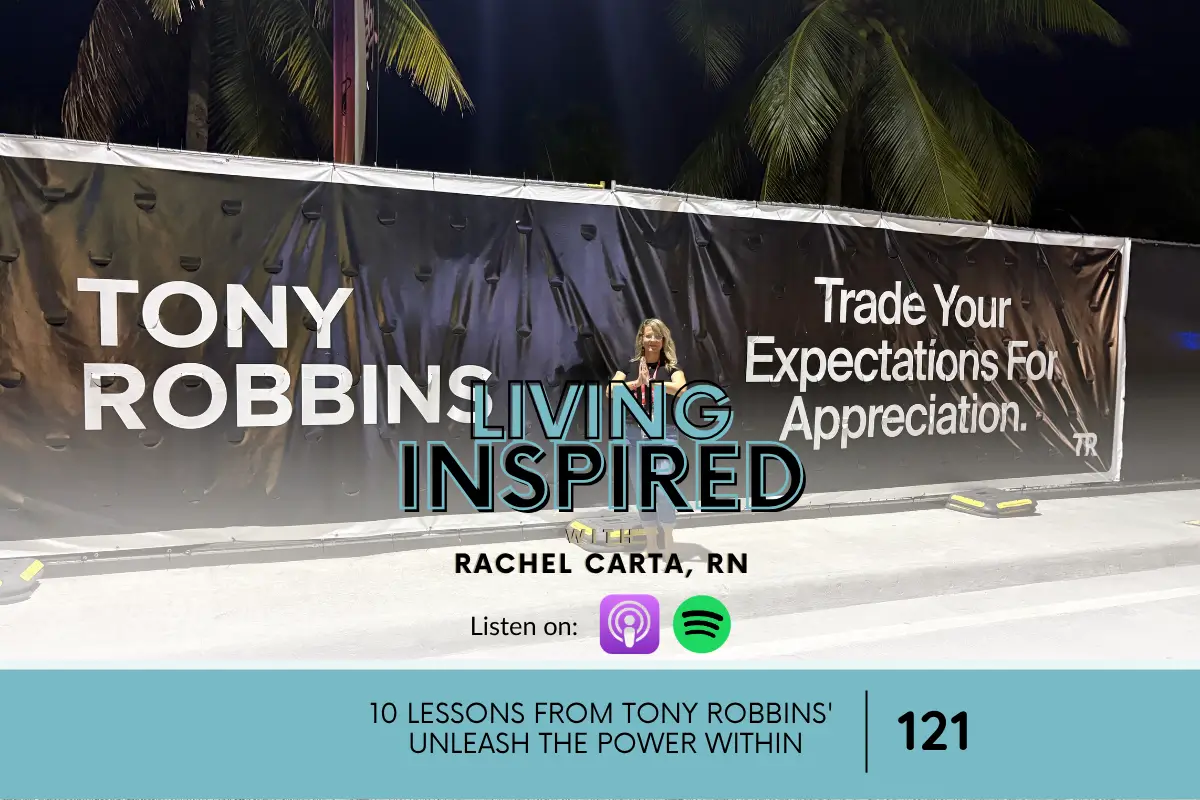
10 Lessons From Tony Robbins' Unleash the Power Within
Custom HTML/CSS/JavaScript
You can listen to the full podcast episode using the embedded player above.
On the Living Inspired podcast, I talk a lot about getting to the root of what's happening in our bodies. Hormones, digestion, sleep, blood sugar, stress. All of it matters, and there's much more of it coming.
There's another part of health that I think deserves just as much attention, and that's how we're actually experiencing our lives. You can have a perfectly planned meal, a supplement list a mile long, and a workout you never skip. If your days are spent overwhelmed, frustrated, or worried about things you can't change, that absolutely influences how you feel.
I know because I've been living it.
In Episode 121, I shared what I brought home from Miami, where I attended Tony Robbins' Unleash the Power Within. It was my fourth event of his, and my first time going in person. Here are the lessons that stayed with me.
Why I Finally Went in Person
For years, going in person felt too hard. Kids, responsibilities, jobs, schedules. I kept telling myself, "Someday I'll go."
But one thing I've learned, personally and through my work as a hospice nurse, is that someday isn't guaranteed. I've sat with people at the end of their lives who still had places they wanted to go and relationships they wanted to repair. I lost my best friend Maria when I had just turned 37. She was 36. I watched my dad carry regrets about things he wished he had done differently.
I still think about a couple I cared for who had been saving to go to Ireland. His wife passed away from cancer a few months before the trip.
So when the chance came up, I thought, "Let's go. I can't wait any longer."
Lesson One: Stop Waiting for the Perfect Time to Live
This is one I still struggle with. It's trying to get everything lined up before you really live. Waiting until your body looks a certain way before you wear the outfit. Saving the fancy dishes for a special occasion.
There will never be a perfect time. There's always another expense, another responsibility, another reason to wait. Many of the women I work with have gotten so used to putting everyone else first that their own health and happiness start to feel optional. "I'll take care of myself when the kids are older." "I'll start exercising when work slows down."
What if everything else is never taken care of?
On the plane, I sat behind someone who was clearly struggling with their health, and all I could think was this: everything I do every day is so I can sit on this plane and travel and do the things I want to do with my child. Every healthy breakfast, every walk, every time I log on to my yoga app when I don't want to, I'm making the rest of my life easier.
What if taking care of yourself is part of what makes the rest of your life easier to navigate? And what if you don't have to earn the right to prioritize your health?
For a long time, I treated life like a dress rehearsal. I'm in my 40s now, and I'm realizing this is it. It's happening now.
Ask yourself: What am I waiting for? What am I waiting to happen before I do the thing?
Lesson Two: Your Energy Changes What's Possible
We were up around 6:00 every morning to get in line, then spent the day in a room with 15,000 people. Most nights ran until somewhere between 10:00 and midnight. There were very few breaks, and eating well was a real challenge (we eventually found a Whole Foods, and next time I'll have a much better snack plan).
But we were moving almost constantly. Jumping, dancing, clapping, celebrating. I got between 12,000 and 20,000 steps a day, and I had so much energy.
I want to be clear: I'm not recommending skipping sleep, skipping meals, or pushing your body for hours every day. Those are not sustainable foundations for health. What fascinated me was how much my emotional and physical state changed when I was moving, surrounded by people who were excited and fully engaged.
I've been a personal trainer. I'm a yoga teacher. I already knew this. Sometimes I need to experience something again to remember how powerful it is.
Think about sitting at your desk for hours. You feel sluggish, so you reach for more coffee or something sugary. Now think about what happens when you put on your favorite song and move for a few minutes, or step outside for a walk. You can feel completely different.
I have a rebounder right behind my chair. How often do I get on it when I'm mentally exhausted? Not often enough.
It is so much easier to change how you feel by moving your body than to try to get your mind in the right place first.
If you're feeling flat, anxious, or overwhelmed, get up and do whatever movement your body allows. Then write the gratitude list or work through what's in the way.
If you're dealing with persistent fatigue, that can be a different story, and it's worth looking at what's happening with your sleep, nutrition, hormones, medications, and other possible contributors.
Lesson Three: Change Your State Before You Try to Change Everything Else
Tony Robbins teaches something called the triad. Our emotional state is influenced by three things:
Physiology. How you're moving and breathing. Sitting slumped with shallow breaths feels different from standing tall and breathing deeply. Try it. Shoulders back, a deep breath, and notice whether something shifts.
Focus. What you're paying attention to. Everything going wrong, or what's working and what you can actually influence? You can shift your focus as fast as a snap of your fingers.
Language and meaning. What you're telling yourself about what happened. One person says, "This is impossible." Another says, "This is difficult, but what's one thing I can do?" The situation is the same. The experience is not.
This is where I had one of my biggest realizations. For much of the past year, I've been navigating some really challenging personal circumstances, and I saw how much energy I've spent trying to make a situation different than it is. I know better. I wrote about it in my book. I still went down that rabbit hole.
Trying to anticipate everything and control outcomes that aren't mine to control has been exhausting, not because I was physically doing more, but because of how much mental and emotional energy I gave it.
Maybe you know that washing-machine feeling. Worry about your kids, your marriage, a family member's health, money, work. Going around and around.
Try a different question: What part of this is in my control? You may not control someone else's choices, but you can decide how you respond. You may not be able to change a circumstance today, but you can set a boundary, or decide how much attention you'll give it.
Changing my mindset hasn't fixed my situation. What it has done is give me back my energy, my focus, and my ability to take care of myself.
Your attention and your energy are valuable resources. You get to be intentional about where you direct them.
Lesson Four: The People Around You Influence Who You Become
One of my favorite parts wasn't even the teaching (and I filled half a notebook). It was being in that room with thousands of people who had invested their time, money, and energy into growing. People working on their relationships, their health, their businesses.
We tend to adapt to the people and environments we're around most. Constant negativity and discouragement can shape how you think and feel. Being around people who encourage and challenge you can help you see yourself differently.
It might not be realistic to surround yourself only with positive people. Life doesn't always work that way. But you can set boundaries, and you can find community, even online. Some of the online events I've attended have filled me up in the same way.
Ask yourself:
Do I have people in my life who encourage my growth?
Do I have people who remind me of my strengths when I forget them?
Do I have people who will challenge me when I'm playing small?
Am I that person for someone else?
This is why I believe community is so important for lasting change. It's very hard to do it alone. Adding a group component to Living Inspired has been a game changer. Getting clients together in one Zoom room, talking and cheering each other on, has been a beautiful thing, because being around people moving in the same direction can help keep you going.
Lesson Five: You Don't Have to Overcome Your Fear Alone
Yes, I walked across hot coals. I have a video, though you can hardly see it because it was so dark and chaotic. I won't forget it as long as I live.
I wasn't nervous at first. Tons of people do it, so obviously it's fine. But as Tony spent hours preparing us, I started to feel the fear. He got us into the most empowered state possible. We moved our bodies, focused our minds, and remembered times we felt powerful. There was also a meditation where I revisited something from my past and saw it through a more empowering lens. I'll tell you about that someday, because it was incredibly powerful.
Then it was time to step forward. It was outside, it was dark, there were thousands of people everywhere, and I froze.
I'd felt that before. Years ago in North Carolina, my friends had a paddleboard way out past some strong waves and wanted me to get on it. I love paddleboarding and I'm comfortable on the board, but I'm scared of the ocean. I was paralyzed. Your body just doesn't want to move.
At the firewalk, one of Tony's crew members stood with me and kept encouraging me. "Make your move. Say yes." She helped me get into the right state so I could physically move, and that encouragement helped me take those steps.
(The firewalk is supervised, with specific preparation and safety procedures, because walking on hot coals carries a real risk of burns. I'm not suggesting you try it.)
What I took from it wasn't that I could walk on fire. It was that I could feel afraid and still move forward, and I didn't have to do it alone.
Think about how often that happens. You want to start exercising, improve your health, set a boundary, or take a step toward something you've always wanted. When the moment comes, you freeze. You second-guess yourself. "Maybe tomorrow."
You don't need another plan or another giant list to make it perfect. You need someone beside you saying, "Let's go. You've got this. Take the next step." That's the power of support and accountability, and I think we underestimate how much it matters.
Lesson Six: Celebrate Your Progress
This one challenged me. I'm not naturally someone who celebrates accomplishments. I finish something and immediately start thinking about the next thing.
Maybe you can relate. You work out three times when you wanted five, and all you think about are the two you missed. You make progress in your career and you're already focused on the next goal.
One of the speakers, Joseph McClendon III (I highly recommend following him on Instagram), talked about how intentionally recognizing and celebrating something helps reinforce the behaviors we want to continue. It isn't a guarantee, but celebration can make progress feel rewarding and tell your brain you want more of it.
Here's a small example. For almost two months, I've been doing a personal challenge to practice yoga every day. Not an hour, just showing up and doing something. I usually practice at the end of the day now, and it's been helping my sleep.
In Miami, one night we got back to our hotel room at 11:59. I'm not kidding. I was about to let the streak go, and then I thought, "No, I am not breaking this streak." I got on my mat, turned on the app, and did five minutes. Just five minutes. I kept the commitment I made to myself, and I was proud of that.
I've often been afraid to talk about my accomplishments, almost like celebrating them would make them stop. I'm learning to change that, because what I'm building isn't only flexibility or strength. I'm building trust with myself. I'm becoming someone who follows through on what matters to her.
Start noticing these moments in your own life. You drank more water today. Celebrate. You took a walk when you didn't feel like it. Hands up to the sky. Say yes. You chose bed over scrolling, or paused before reacting to something that would normally upset you. Celebrate. It matters.
Progress deserves recognition even when it looks small. In my groups, we celebrate our wins together every time we meet, because we have to teach our bodies that we want more of what we're celebrating.
Lesson Seven: The Stories You Tell Yourself Matter
We all carry stories about who we are, built from our experiences, our relationships, and the things people have said to us over and over through the years. Some of those stories help us. Some limit us.
One of mine, and I know I'm not alone, is about not being good enough. Not doing enough, not accomplishing enough. I've talked with so many capable, caring, intelligent, accomplished women who feel like they're falling short. They compare themselves to others, focus on what they haven't done, and read every setback as evidence that something is wrong. Over time, those stories shape the choices they make.
What I love about Tony's work is the invitation to question these stories. Is this actually true, or is it an interpretation I've carried for years? (Byron Katie also does wonderful work on this.) Ask yourself:
What else could this experience mean?
What would I do differently if I didn't believe this story about myself?
I remember a really difficult time when I sat in my doctor's office talking about whether an antidepressant might help me. I was struggling. I made a personal commitment to spend the next 30 days working on my mindset, listening to Tony's teachings and using other tools I had learned. Ultimately, I did not start that medication.
I want to be very clear: this is my experience. I'm not suggesting anyone delay, stop, or avoid medication or mental health treatment, or that you can simply think your way out of depression. Depression can require professional care, and medication can be an important and life-saving part of treatment. What my experience taught me was how much my thoughts, my interpretations, and my daily mental health habits mattered to my own wellbeing.
That's part of why I keep going back to Tony's events. Not because I haven't learned, but because every time I immerse myself in these ideas, I'm reminded to practice them. It's the same reason I reread certain books.
Lesson Eight: Trade Your Expectations for Appreciation
This is one of my favorites (I know I keep saying that). Think about how much suffering we create when we're attached to how things should be. Our spouse should respond a certain way. Our children should behave a certain way. Our bodies should look and feel a certain way. Our lives should be further along by now.
When reality doesn't match, we feel frustrated, disappointed, angry.
That doesn't mean giving up standards. Healthy relationships need boundaries, respect, and accountability, and appreciating someone doesn't mean accepting harmful behavior. There's a difference between healthy standards and constantly fighting reality because it doesn't match the picture in your mind.
I realized how much of my energy went into that fight, and honestly, I had to grieve it. Now I'm practicing something different. With my children, I'm listening more and being more present, appreciating who they are instead of always thinking about what needs to change. In my relationships, I'm noticing what I genuinely appreciate while still being honest about what needs attention. Even with my body, I want to appreciate what it lets me do instead of focusing on how I want it to be different.
Tony often says that what's wrong is always available, and so is what's right. Your challenges may not disappear, but they may have a little less hold on you when you're paying attention to what you appreciate instead of what you expected.
Lesson Nine: Raise Your Standards and Keep Your Commitments
One of Tony's recurring messages is that lasting change happens when something moves from a should to a must. I should exercise. I should eat better. I should get more sleep. As Tony puts it, we're "shoulding" all over ourselves.
I think those things keep getting pushed aside because we haven't decided what we're committed to. We're still treating our wellbeing as something we'll get to when everything else is done.
What happens when taking care of yourself becomes part of who you are? Not in a rigid, all-or-nothing way, but as a commitment to keep returning to what matters.
In Episode 120, Tracy and I talked about resuming, not restarting. That's what my daily yoga practice keeps teaching me. Some days it's a full practice. Some days it's five minutes. I keep showing up, and I'm becoming someone who can trust herself to take the next step even when life interrupts the plan. When life interrupts you, and it will, you don't have to start over. You resume.
What is one area of your life where you're ready to raise your standard? Your sleep, how you speak to yourself, boundaries around your time, or finally getting support for the health issues you've been putting off? You don't have to change everything. You can decide that one thing matters enough to treat it differently.
Lesson Ten: Information Doesn't Create Change Until You Take Action
I've invested in Tony Robbins four times, plus plenty of his free material. Someone might wonder why I keep going if I've already learned these things.
I have learned many of them. But learning something and living it are not the same. I know movement supports my energy and mood, and I don't always get up and move. I know worrying about what I can't control drains me, and I still fall into it. I wrote a whole chapter of my book on gratitude, and I don't practice it every single day.
That's why I believe so strongly in immersion, repetition, coaching, and community. We need reminders. We need support when life gets hard. And sometimes we need someone to help us see the patterns we can't see on our own.
How much information do you already have? How many books, how many podcasts? Usually the answer isn't learning ten more things. It's identifying the one thing, or the few things, that matter most and actually doing something with them.
Choose One Action
I don't want you to finish reading this inspired and then go right back to the same patterns. Pick the one of these that could make the biggest difference for you:
Change your physical state. If you feel mentally stuck or sluggish, move. Walk, dance to a favorite song, stretch, do some yoga. Then notice how you feel afterward.
Find your biggest mental energy drain. Ask, "What am I spending energy trying to change that I don't have control over?" Then ask, "What part of this can I actually influence?" Maybe it's a conversation, a boundary, something to release, or support for something too big to carry alone.
Stop postponing something that matters. What have you been saving for someday? Your health, a trip, time with someone you love, something you've wanted to learn? Take one step today. Not next month. Today.
I want to hear which one you chose. Find me on Instagram at @peaceinperimenopause.
If You Don't Know Where to Begin
Maybe you're reading this thinking, "Rachel, I know I need to make changes, but I'm so exhausted and overwhelmed I don't know where to start."
So much of what I experienced in Miami reinforced why I created the Living Inspired Life Lab. It's a 12-week experience where we look at the foundations that influence how you feel, including sleep, blood sugar, your nervous system, digestion, movement, and the patterns in your everyday life. We work on understanding what's happening, identifying meaningful changes, and building habits that fit your real life, with guidance, structure, accountability, and a community of women making their wellbeing a priority.
The next group begins January 4. Applications are open now. You can read about the program and schedule a short call at rachelcartarn.com/lifelab. Let's talk about what you're experiencing and what you want to change. If none of the available times work, reach out by email and we'll find another.
You Don't Have to Walk on Hot Coals
You don't have to walk across hot coals to change your life (though it was very cool). You don't have to attend a massive event or wake up tomorrow as a different person. But you can decide that your energy matters, your health matters, your dreams matter, and that you're no longer going to put your own life on hold while you wait for everything around you to be perfect.
I came home with plenty to work on, and I'm still figuring some of it out. What I know is that I want to be intentional about how I spend my energy and how I experience my life. I don't want to just get through it. I want to live it, and I want that for you too.
Lots of love,
Rachel
Rachel's Free Resources:
Mood Swings? Get the 5 minute audio to calm them now. https://rachelcartarn.com/sos
Do you want to understand more of what's changing in your body in midlife and get a few simple tools to feel better now? Get the free guide: The Real Reason You Still Feel Off.
Ready to Talk: Book a Clarity & Relief Session here.