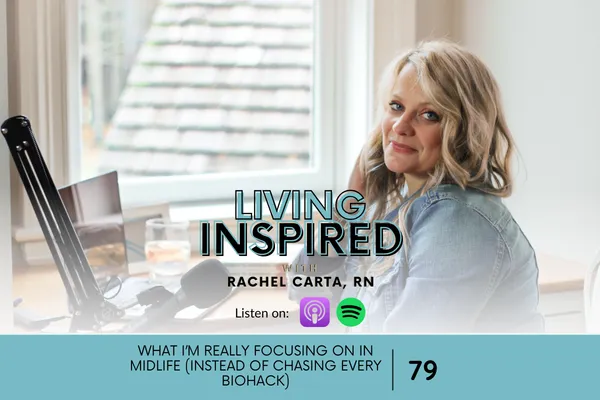
What I’m Really Focusing On In Midlife (Instead Of Chasing Every Biohack)
Listen to the full episode above or on Apple or Spotify.
Midlife is not the end. It is the beginning of awareness, and awareness is the gateway to choice and freedom.”
- Rachel Carta, RN
Open your phone and start scrolling and you will see it. A parade of things you are “supposed” to do in midlife if you want to feel better.
Supplements lined up on the counter. Endless diets to try. Bioidentical hormones. Cold plunges, saunas, red light panels. Strength training, but not too much cardio. Track your sleep, your cycle, your blood sugar, your steps, your stress. And SO MUCH MORE. It's a lot.
As I sat down to outline this episode, I actually made a list of all the things the internet says women in midlife should do. It went on and on, and I could feel my own nervous system speeding up as I read it out loud.
Some of the tools on that list are great. I use several of them. The problem is not the tools themselves. The problem is the way it all lands on us as women who are already tired, already carrying so much, already trying to keep everything and everyone afloat.
No wonder you feel overwhelmed.
So in this season of my own life, I am getting really honest about two things: 1. What I am choosing to focus on? 2. What I am finally willing to release?
And I want to invite you into that conversation with me.
When Your Pace Starts To Cost You
I'm a midlife woman with a full plate, just like you. I'm running a business, working in hospice, parenting, being a partner, staying in touch with friends, trying to stay grounded in my faith, and doing all the invisible emotional work that women do every single day. For a long time, I tried to keep up by simply pushing harder. More saying yes. More squeezing work into every free moment.
From the outside, it looked like I had it together. On the inside, I was falling apart. My chronic migraines really surfaced in 2020. There were seasons when I had twenty to twenty five migraines a month. That level of pain will bring you to your knees. It took me years to understand what was happening and to see how my pace, stress, and nervous system were woven into it.
I also noticed it in the quiet moments at home. My son is the joy of my life. He is always making sounds and music. He even beatboxes with his voice. When I'm rested and present, his creativity makes me smile. When I'm exhausted and stretched thin, that same joyful noise can send me over the edge.
There was a day I snapped at him when he was happily making music, and I saw his face fall. In that moment, I felt the sting of misalignment.This is not the kind of mother I want to be.
If I believe I'm a present, loving mom who delights in her child, yet my pace keeps eroding that identity, something has to change.That was a turning point. Not toward another protocol or plan, but toward something different: Listening.
The Thing All The Biohacks Are Missing
I have nothing against tools. I use strength training. I use certain supplements. I love some of the nervous system practices and I teach many of them.
But none of those things matter if we skip the foundation.
If your stress is an eight out of ten every single day, if you have been sleeping five hours a night for months, if you are sprinting on fumes, there is no pill, patch, or program that can rescue you from that.
At some point, we have to stop looking outside and start listening inside.
That shift changed everything for my migraines, and I see it over and over again with the women I work with. What moves the needle is not more intensity. It is what one of my guests once called being“boringly consistent”with the basics that truly support your body.
So instead of chasing every new trend in 2026, here is what I am actually focusing on.
What I’m Focusing On In 2026
These aren't glamorous. They aren't viral. They aren't quick fixes. But they are real. And they are working.
1. Lifting Weights Like I Mean It
I have been a personal trainer since 2010, and for years I lifted regularly. When my migraines worsened and we moved to a new state, I drifted away from strength training because even the pressure of lifting could trigger an attack. Now that my migraines are better managed, I'm back in the weight room three times a week for about thirty minutes. Nothing complicated. Just consistent, full body strength work, lifting weights that feel challenging so that the last few reps take effort.
Women often worry they will “bulk up.” I used to show my own body as an example. Even when I was lifting heavy and working hard, my body did not suddenly become bulky. Our hormones simply do not work that way. You deserve the strength, bone health, and confidence that come with resistance training.
2. Walking For Sanity, Not Perfection
Instead of chasing 10,000 steps, I am aiming for 8,000. For my brain, that number feels doable. If I am at 6,000 steps, it feels easy to get outside and take another short walk. Two twenty to thirty minute walks a day usually get me there, plus regular movement during my day. The point is not the exact number. The point is a realistic target that nudges me into movement without tipping me into failure mode. I also write my steps in my calendar. It's not for judgment. It's for momentum. I like to visually see the days I followed through on what I said I would do. Confidence grows when we do what we say we are going to do.
3. Protecting My Sleep As A Non-Negotiable
Because of my history of migraines and neck pain, I'm currently doing physical therapy and I have turned those exercises into a nightly wind down ritual. For a long time, my default was to watch a show at night. There is nothing wrong with a show. But for my body, the scroll and the streaming were not helping me settle. So I started using an app called Roots that blocks certain apps at certain times. I blocked Instagram, Netflix, and Facebook in the morning and evening, and only gave myself a small window midday to use them. Now when I reach for my phone at night out of habit, I get blocked. That tiny pause creates just enough space to pick up a book instead, or to lean into my physical therapy exercises and gentle breathing. My body is settling more easily, and my sleep is better for it.
4. Slower, Kinder Mornings
I love slow mornings. Sometimes I journal and meditate first thing. Sometimes I wake up in a creative flow and need to write something for you immediately. Instead of forcing myself into one scripted routine, I'm practicing a gentler structure. Hand on heart. A moment to ground and be here. A simple mantra and breath. Then I ask what is actually needed: reflection, creativity, or quiet. The key is giving myself enough time so I am not rushing right out of bed into productivity mode.
5. Real, Deep Connection
My soul has been asking for this. I'm not built for endless small talk. I can do it, but it feels like eating cotton candy when what I really want is a nourishing meal. At the start of the year, I went to a women’s brunch at a local yoga studio. There were about forty women in the room. I could feel the connections forming as we talked. Women who wanted to go deep. Women who were hungry for real conversation.
If you have felt lonely in midlife, please know that you are not the only one. Marriage can feel hard. Friendships shift. Kids grow. Bodies change. Hormones change. The ground under your feet can feel unfamiliar. Part of my focus this year is intentionally seeking out circles where we talk about the real things. Health, grief, identity, faith, desire, purpose. Life is too short for everything to stay on the surface.
The First Generation Naming What Our Mothers Lived Through
At that brunch, a woman told me, “perimenopause was not even a thing five years ago.” Of course, it has always been a thing. Our bodies did not suddenly invent this life stage. We just did not have the language for it.
Think about your mother or grandmother. Maybe you remember her unraveling a little in midlife. Losing her patience. Crying in the kitchen. Feeling “hormonal” or “crazy.” Maybe she disappeared into caretaking and no one asked how she was really doing. She was likely in perimenopause. She simply did not have the words, the information, or the support we have now.
We are the first generation talking about this openly. We have Instagram accounts devoted to perimenopause, doctors who are starting to pay attention, practitioners who are looking at the whole picture. We can text a friend and say, “Are you itchy all over for no reason?” or “Do you ever feel like you hate your husband for no reason?” and we can laugh and cry about it together. That alone is revolutionary. And it is why I feel so called to this work.
What I’m Releasing In 2026
It is not enough to choose what to focus on. We also have to be honest about what we are ready to let go of.
Here is what I am actively releasing this year:
The need to control everything
The pressure to get it all right
The instinct to outrun pain by working harder
The belief that my worth is tied to my productivity
The idea that I have to keep up with women who live completely different lives than I do
I am learning to see my limitations not as failures, but as feedback.
I'm admitting where I push too far. I'm noticing where old identities still drive my behavior, like the part of me that jumps up from the couch if my husband walks in, so I do not look like I am resting. This is a work in progress.
Naming these patterns does not make them vanish, but it does invite honesty. Awareness is humbling. It's also where change becomes possible.
So here's your invitation: What are you willing to let go of this year? Where are you saying yes when the real cost is your health, your peace, your energy, your presence with the people you love? What would it look like to leave more space on your calendar on purpose You deserve rest that counts, not rest you have to hide.
Letting Your Symptoms Become Signals Instead Of Enemies
For years I have said, “Your symptoms are signals.” They're not proof that your body is against you. They're your body trying to get your attention. One of my clients told her story on this episode, and I want to share a piece of it with you because it captures what so many women feel.
When she first met me at a yoga event, she was exhausted and burned out from trying to figure everything out on her own. She had seen doctor after doctor, tried different medications and approaches, and still felt terrible. She wanted a more holistic view, but she did not know where to find it. She said that when she heard me talk about looking at her health, hormones, and the big picture together, something clicked. Sitting there on her yoga mat, she thought, “This is what I need.”
At the start of our work together, she felt hopeless and alone with her symptoms. She would wake up, list every ache and pain out loud, and feel angry at her body for not cooperating. There was no curiosity, just frustration and self blame. As we worked through her story, we did not just list symptoms. We traced them alongside her life. Stress, grief, big transitions, food patterns, sleep, nervous system load. We laid the puzzle pieces on the table and slowly began to see the picture.
Now when a symptom shows up, her first reaction might still be “Ugh, my back,” but it does not stop there. She asks: What did I eat? What happened yesterday? Was there a hard conversation? How have I been sleeping? What has my stress felt like? She described it as clicking puzzle pieces together instead of sitting in a pile of broken pieces. As that inner connection grows, her sense of power grows too. She told me she finally feels hopeful. Not because everything is magically fixed, but because she understands herself in a new way and has tools she can actually use. She no longer has to carry the weight of figuring it all out alone.
That is the heart of this work. When you listen to your body and view your symptoms as communication, the conversation changes. The question is no longer “Why is my body doing this to me?” It becomes “What is my body trying to tell me, and what needs care right now?”
Midlife As The Beginning, Not The End
Midlife is not a dead end. It's a doorway into awareness. Awareness leads to choice.
Choice, over time, leads to freedom. So as you look at your own year, ask yourself: What small, “boringly consistent” habits could quietly change everything for you? What is your version of lifting weights three times a week or walking 8,000 steps? What would help your nervous system settle before sleep? What kind of real connection is your heart craving? And just as important, what beliefs about productivity, worth, or “keeping up” are ready to be released? Your body has been talking to you for a long time. Maybe this is the year you truly start to listen.
Ready For Support On Your Own Midlife Health Story?
If you have been listening or reading and something in you is whispering, “This is what I need,” I want you to know you do not have to figure this out alone. If you're tired of trying different plans and still feeling off, if you sense that your symptoms are connected but no one has helped you see the whole picture, we can change that.
You can learn more about working with me and book a Clarity and Relief Session. We will talk about what is going on in your body, what is draining you, and what small hinges could finally move the big doors in your health.
And if you are not ready for a call yet, you can start with my free resources designed to help you feel more clear and calm in your body:
The Real Reason You Still Feel Off
Partner Communication Guide for Perimenopause
You deserve care that sees the whole you.
Lots of love,
Rachel